


Why Anthropic’s Compute Bill Grew Faster Than Claude Revenue
By Edward Chenug
Anthropic’s November 2026 prospectus described a business adding more than $5 billion of quarterly revenue while returning to an operating loss. It was buying immediate computing capacity at the same time it contracted for capacity that would be delivered over several years. The timing of those purchases helps explain why high gross margins, richer demand and slower operating leverage could coexist.
Revenue and compute moved at different speeds
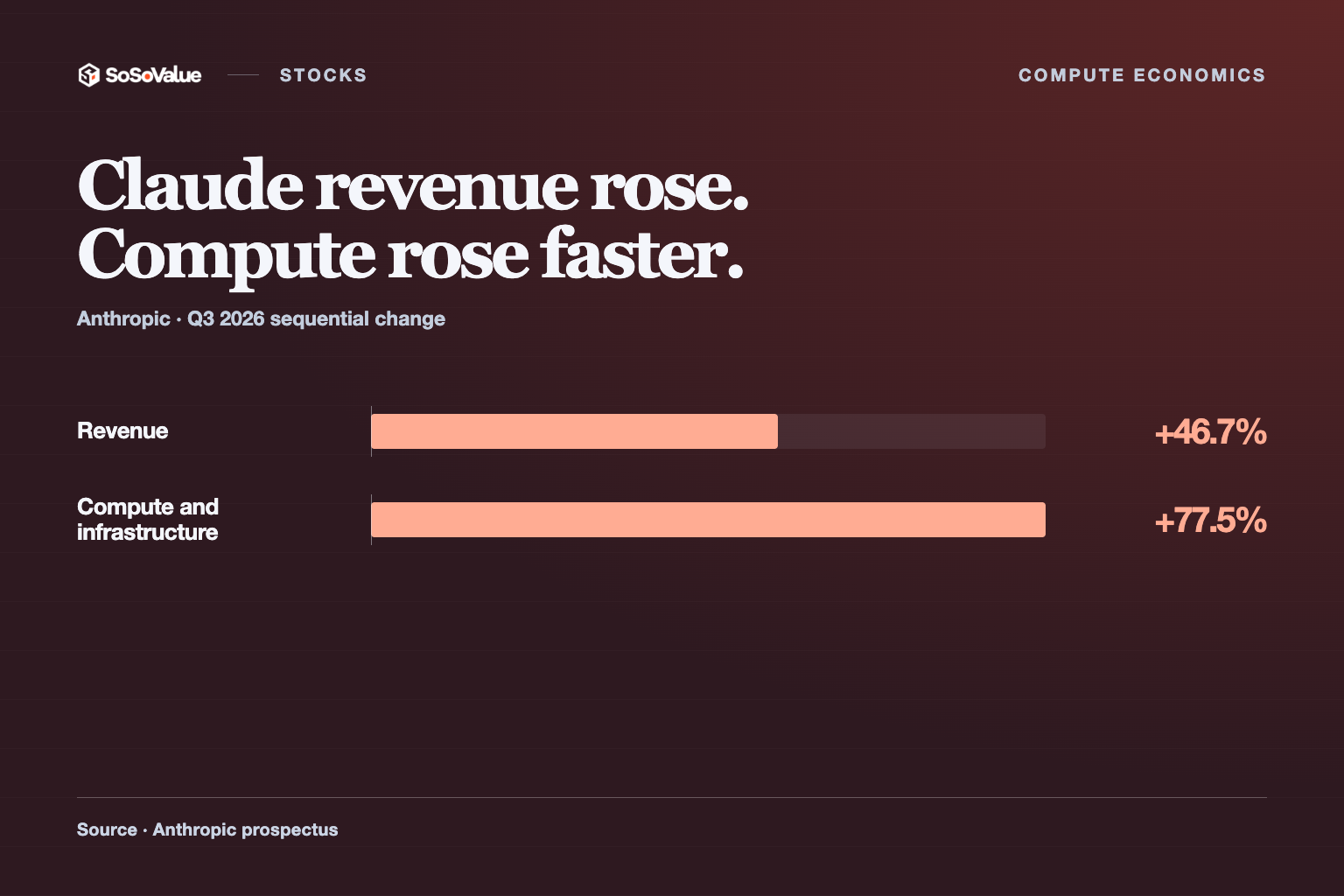
Anthropic said it took delivery of roughly $5 billion of relatively expensive computing capacity under short-term commitments to meet demand in Q3. Revenue grew 46.7% sequentially and reported compute and infrastructure expense increased 77.5%.
In Q2, Anthropic generated $11.56 billion in revenue on $5.56 billion of compute and infrastructure expense. In Q3, the corresponding figures were $16.96 billion and $9.86 billion. That is about $2.08 of revenue for each dollar of infrastructure expense in Q2 and $1.72 in Q3. These are companywide figures that include infrastructure for development. They track pressure on the aggregate cost base across quarters.
Gross margin answers a narrower question
A reported gross margin around 85.5% captured the costs classified in cost of revenue. Computing used for model training and research can appear elsewhere in the accounts. Use gross margin to understand the reported delivery economics, operating margin to include additional spending, and cash flow to understand when bills are being paid.
The expense mix showed up differently in the GAAP and adjusted results. GAAP operating income went from a $974 million profit to a $567 million loss. Adjusted operating profit increased to about $2.46 billion, but its margin slid to 14.5% from 19.3%. Using the adjusted measure alone would miss the size of the GAAP reversal. Looking at the two margins together shows that underlying revenue was also growing faster than its adjusted profit.
Commitments put utilization at the center
The company disclosed roughly $900.9 billion of purchase and lease commitments across future periods. Those obligations are spread over time. Their economics depend on when the capacity arrives, how much can be shifted from short-term contracts and how much paid demand the dedicated capacity can serve.
The longer commitments offer a route to cheaper capacity per unit, depending on utilization. About $70.7 billion of disclosed purchase and lease commitments were expected in the twelve months after September 30, with many more extending beyond that window. Extra capacity can improve the economics if earlier short-term rentals roll off and customers keep consuming the new supply. If deployments are delayed or usage grows more slowly, obligations continue to come due before the expected revenue.
The useful financial test in a later filing is therefore to compare quarterly infrastructure expense, operating results and cash payments as new capacity comes on line. Growth in revenue alone can mask the difference between an efficient transition and a period in which the company is paying for several types of capacity at once.