


What Sixfold Demand for Anthropic’s IPO Actually Measured
By Edward Chenug
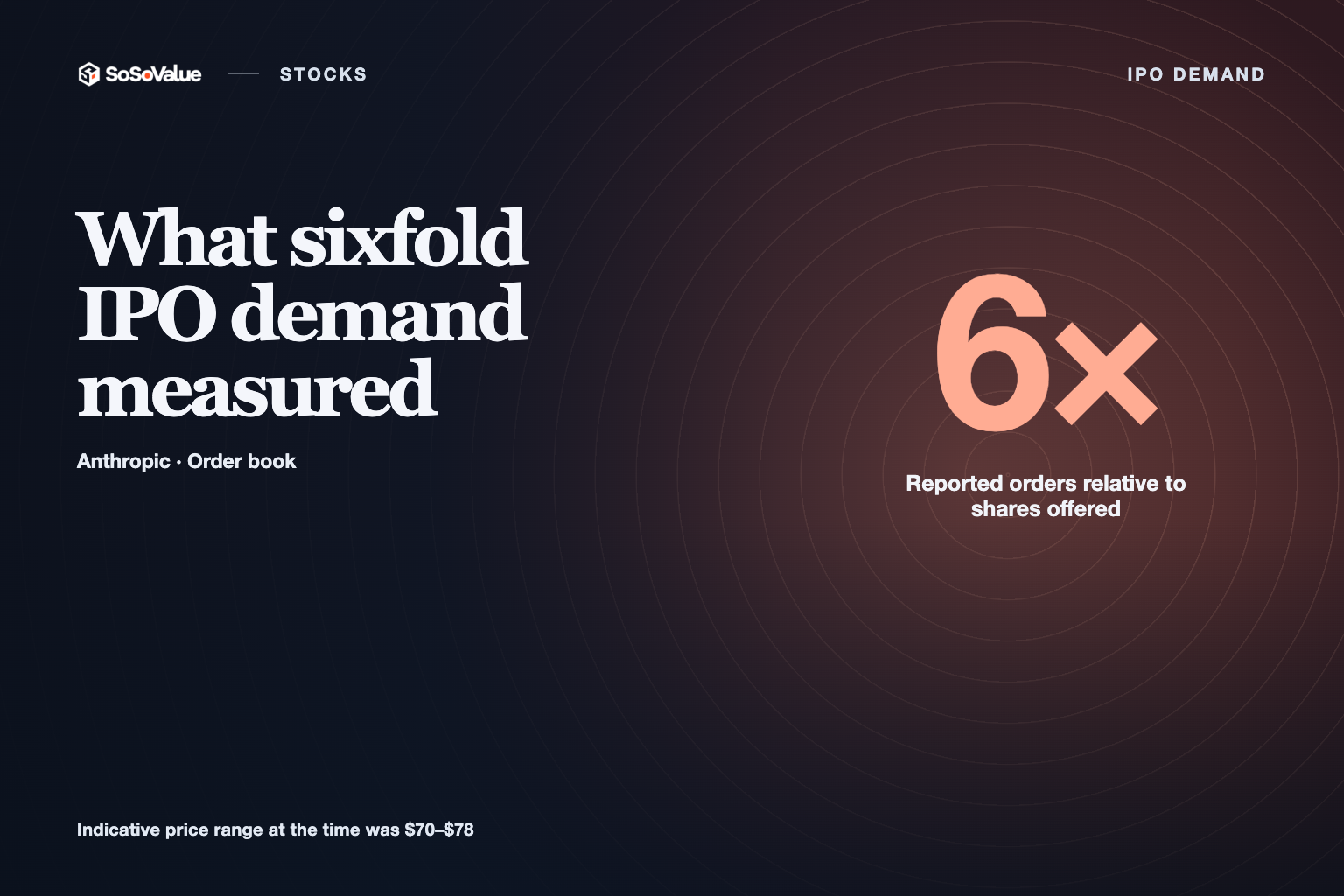
Six orders for each share on offer sounds like a definitive vote of confidence. The reported order book for Anthropic’s IPO described demand at a set of terms that were still being negotiated. With the company marketing a $70–$78 range in mid-November, investors were responding to both the price and the scarcity of the first allocation.
The order book had a price attached
Ahead of the November 2026 listing, Bloomberg reported that Anthropic had orders for about six times the shares offered. The initial $70–$78 range implied a fully diluted valuation of up to about $1.4 trillion, below earlier market discussion of roughly $2 trillion. Changing the price or the number of shares can change the quality of the demand those orders represent.
At $78, the preliminary public deal amounted to about $64.4 billion. The $26 billion private placement gathered separately from the book was disproportionately backed by Google and Nvidia, which agreed to invest $10 billion each. Their participation brought in money from large technology companies with commercial links to the AI infrastructure the issuer required. That was a distinct source of financing from demand among institutions seeking public shares.
Allocation changes the first day
A fund expecting a small allocation can submit a larger order. It may buy more when trading opens, depending on the price. Existing holders eligible to sell can supply shares at the same time. That is why investors should read reported subscriptions alongside public float and lockup exceptions.
Prospectus provisions allowed some eligible holders to sell part of their stock from the first day. Other holdings were subject to lockups of up to 180 or 365 days. Scarcity could support the opening price while more shares remained restricted. A fund that entered an order while expecting a fraction of it to be filled would have to make a new investment decision about buying additional shares at the price that prevailed after listing.
Customer spending is the longer test
More than 11,900 Anthropic customers had each generated at least $100,000 in trailing 12-month revenue at September’s end. That breadth gives the growth case a business foundation. Operating returns depend on whether paying usage can grow faster than the cost of serving it, a test that continues well after the book closes.
The business behind the book had gained real scale. The count of customers generating $100,000 or more over the preceding twelve months had risen from more than 950 a year earlier, and more than 1,900 had reached $1 million by September 2026. At the same time, the third-quarter sequential growth rate slowed to 47% from 144% in the second quarter. An $81 billion October run rate described current momentum. A shareholder still had to ask how much the company could earn on the dollars it was converting into revenue.
A valuation of roughly $1.4 trillion at the top of the range put a steep price on that future earnings stream. Even an illustrative $100 billion of annual revenue at a 20% net margin would leave a valuation around 70 times net income. The order count was a signal of appetite under the marketed terms. Sustained and efficient expansion carried the valuation case after the flow of new shares cleared.