


Why an Extra $2 Would Have Moved Anthropic’s IPO Value More Than Its Cash
By Edward Chenug
A company can add tens of billions of dollars to its market value with a small change to its IPO price and collect much less in extra cash. Anthropic’s November 17 prospectus put a number on that gap. The company’s original terms separated three moving parts: the price investors paid, the number of new shares the company sold and the number of existing shares that could reach the market.
Repricing a deal reprices the whole company
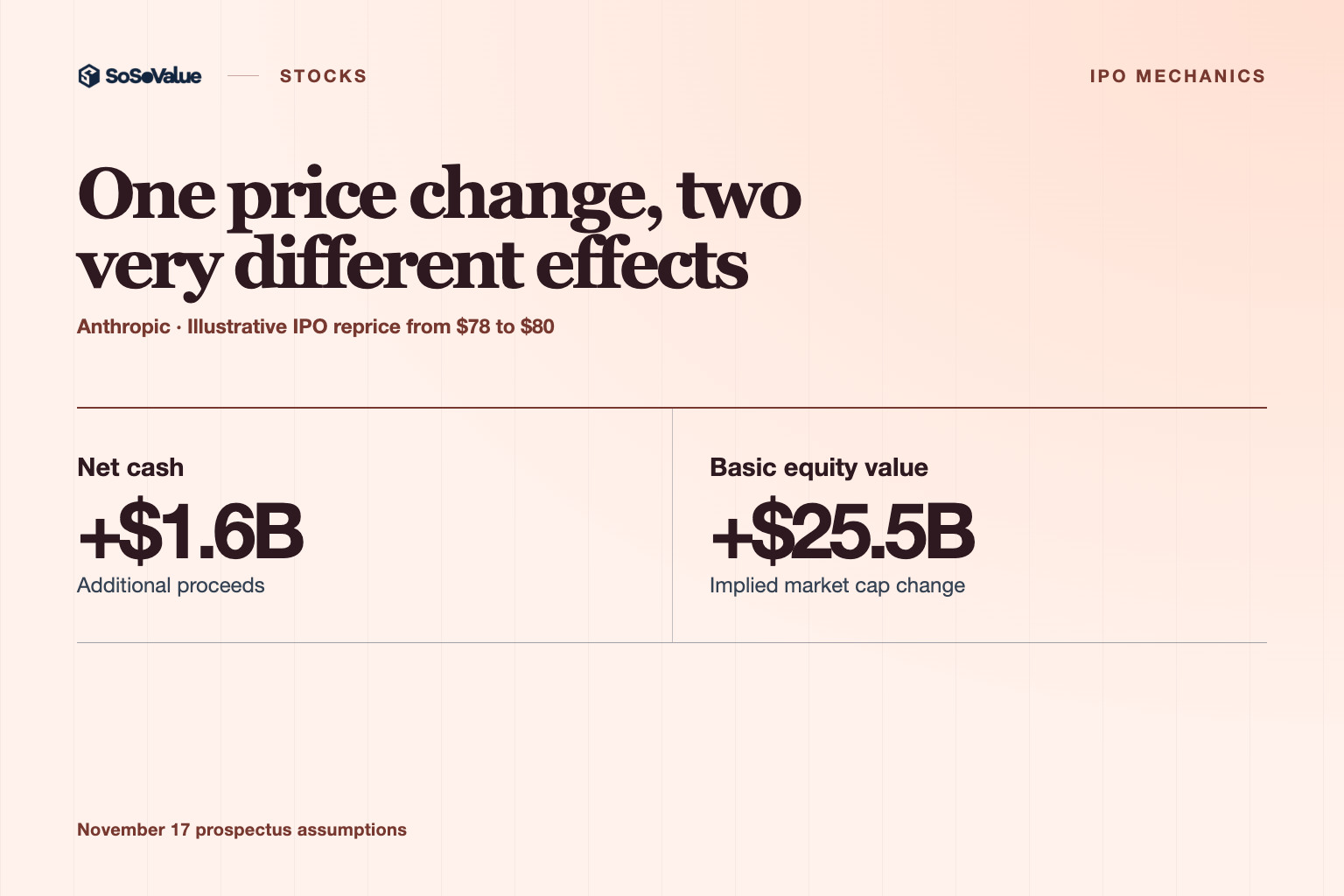
At the November 17, 2026 filing terms, every $1 on the offer price would have added about $793 million in net proceeds at a fixed new-share count. Moving from $78 to $80 on those assumptions would have raised about $1.6 billion more for Anthropic and added roughly $25.5 billion to its basic equity value. The difference comes from applying the new price to all post-offering shares.
Under those filing terms, the base offering of 825 million shares would have been worth $57.75 billion at $70 or $64.35 billion at $78. It included shares sold by existing holders. The associated $26 billion placement was fixed in dollars, so a higher price would reduce the share count allocated to those partners instead of increasing the cash they contributed.
The basic valuation applies the same price to all ordinary shares outstanding as the deal closes. A fully diluted estimate also considers securities that could become shares, which explains why the top-end diluted estimate near $1.4 trillion exceeded the roughly $1.02 trillion basic value at $78. The metric investors use should match the share count behind the comparison.
Headline demand sits alongside potential supply
Reported roadshow orders reached roughly six times the shares available. Some institutions could have ordered more in anticipation of partial fills. Meanwhile, up to 315 million shares held by eligible insiders could potentially trade on day one, equivalent to roughly 38% of the then-planned base offering. Eligibility indicated possible supply, with actual sales left to holders.
Bloomberg reported bids of at least $10 billion from multiple investors. A single bid of that size was equivalent to roughly 16% of the public offering at $78. Large orders can reflect expectations of being scaled back. Meanwhile, employees and other holders with permission to sell could meet some of the residual demand, depending on their willingness to sell at the opening price.
Why the final deal looked different
Anthropic ultimately priced at $83 and increased the offer to 980 million shares. Because both price and size changed, the earlier $793 million sensitivity illustrates the original deal mechanics and should be read on those terms.
By the end of October, Anthropic’s revenue run rate had grown to $81 billion from about $71 billion a month earlier. That figure annualized a recent pace of usage and subscriptions. Period revenue and margins give a more grounded comparison with the valuation set during the bookbuild. The company reported about $33.2 billion of revenue for the first nine months of 2026 and swung to a third-quarter GAAP operating loss. A stronger IPO price brought the company more cash, while asking new shareholders to pay more for the earnings that capacity may produce.