


Why Cheaper Claude Workloads Can Still Raise Enterprise AI Bills
By Edward Chenug
An enterprise can spend more on Claude even when its cost per task declines. The mechanism resembles any technology that makes new work economical: teams try it in one setting, expand to other workflows and increase the number of jobs done by the system. At Anthropic’s IPO roadshow, customer spending and product adoption offered a way to assess how quickly that process was taking hold.
A cheaper task makes more tasks economical
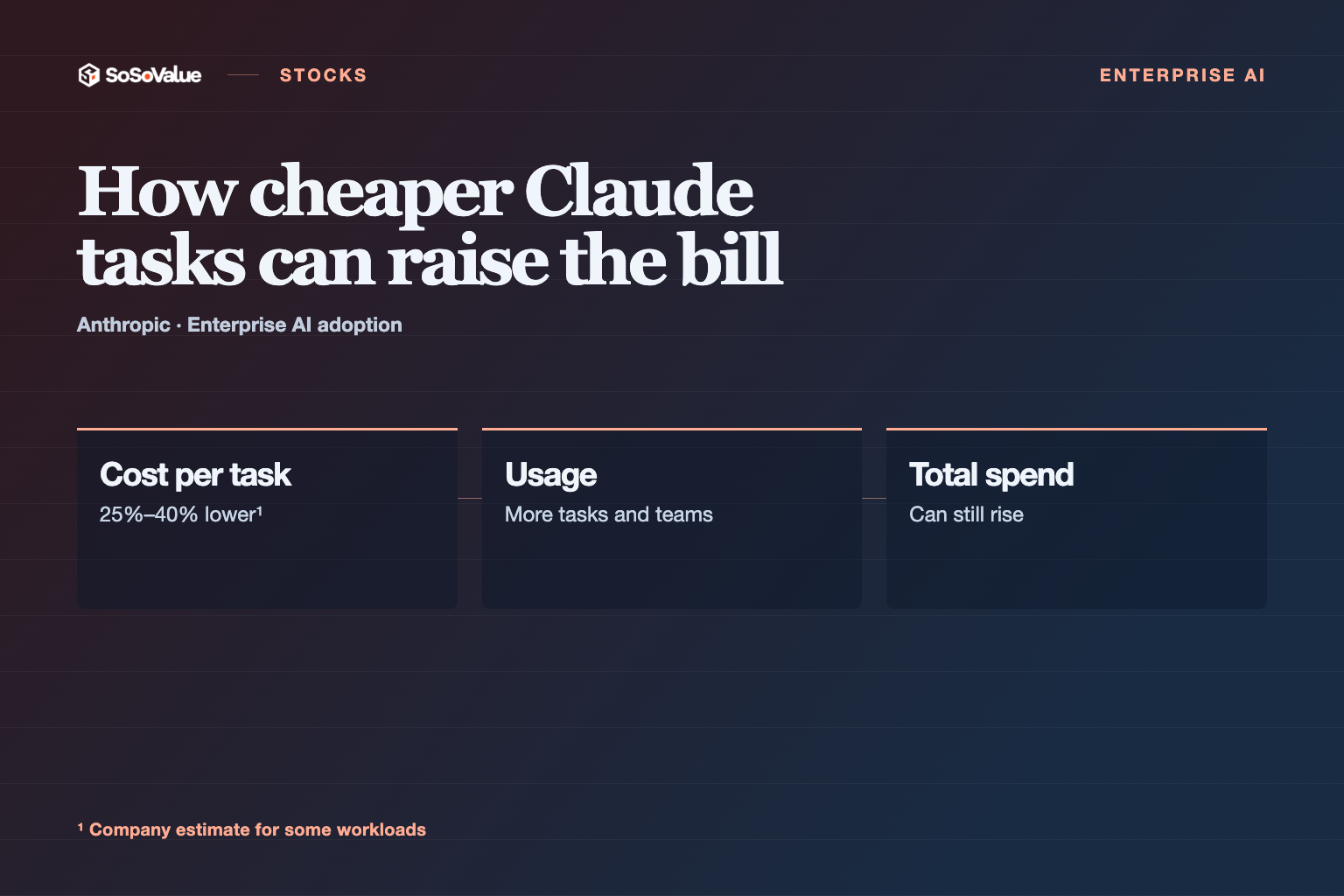
Anthropic estimated that some newer models cut the cost of running comparable workloads by about 25% to 40%. If an enterprise can process a document or generate a test at a lower cost, departments may automate more of those tasks and find new ones worth automating. Total spending can rise when the increase in usage outpaces the decline in price per task.
A team using Claude for coding might start with a small group of developers, add testing and documentation, then expand to other teams that can use the same approved platform. An enterprise that halves the cost of completing a task and triples its volume would still raise its spending by half. The example is illustrative. What matters for Anthropic is the balance of real usage growth and price changes across the mix of workloads.
Read the cohort behind the retention number
Product use also broadened. More than half of customers generating at least $100,000 in trailing revenue used both the platform and an application in the third quarter, up from about 30% in the final quarter of 2025.
By September 2026, more than 11,900 customers had generated at least $100,000 in trailing twelve-month revenue, up from about 1,500 at the end of 2025. More than 1,900 had reached $1 million and about 250 had reached $10 million. The roughly 900% retention metric compared current-quarter revenue from qualifying earlier customers with that same group’s revenue in the corresponding earlier period. It was heavily influenced by customers expanding from a much smaller base.
Customer concentration fell as that base broadened. The five largest customers generated about 21% of third-quarter revenue, down from 36% in the first quarter, even as each of the five recorded its highest quarterly spend. That combination points to growth among other accounts as well as deeper spending at the largest ones.
Customer savings and Anthropic’s margins can diverge
A cheaper task can benefit the customer immediately. Anthropic earns more from broader adoption if better utilization and model efficiency reduce its own costs fast enough. The strongest evidence would be expansion beyond coding alongside repeatable improvements in revenue per dollar of infrastructure expense.
A workplace can decide to use another model for general inquiries while retaining Claude in a workflow where it proves reliable. Better integration, permissions and auditability can help defend that work. The continuing benefit to Anthropic depends on customer renewals and usage after the initial deployment, as well as how much cheaper the model becomes to operate. Expansion into new tasks has to lift aggregate revenue fast enough to cover the infrastructure needed to serve them.