


Why Cloud Giants and Neoclouds Split After the US Midterms
By Edward Chenug
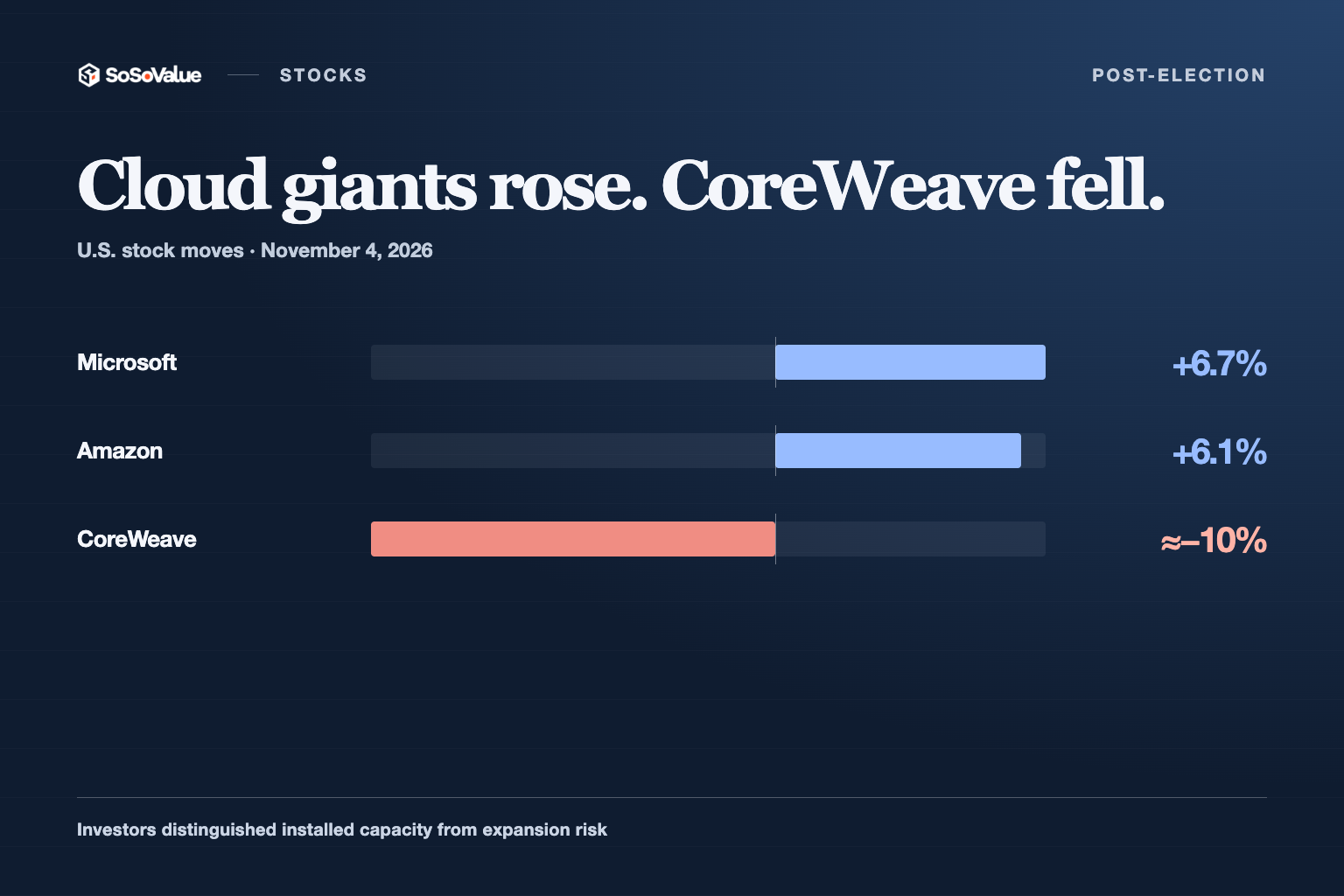
Microsoft and Amazon rallied after the November 2026 midterm elections while CoreWeave fell about 10% on the same day. Investors saw more scrutiny of data center construction and power demand ahead. Their first response was to put a higher value on computing facilities that could already bill customers and a lower one on projects that still needed more money and time.
Installed capacity can gain value
On November 4, 2026, Microsoft rose 6.7% and Amazon gained 6.1%, while CoreWeave fell about 10%. Investors initially viewed greater scrutiny of new data centers as a reason to value capacity that was already running.
Microsoft was able to cover expansion with cash from an established business. Azure revenue grew 48% in its fiscal first quarter, while group operating cash flow reached $58 billion and free cash flow $18.6 billion. Existing sites gave the company a way to keep serving demand. Management also expected more than $50 billion in capital spending the following quarter, and some third-party capacity was running late. An installed base protects part of the business while new construction remains important to growth.
A backlog cannot pay the interest bill by itself
For a neocloud, an order can require leases and equipment long before it starts generating cash. CoreWeave’s prior quarterly figures put net interest expense at around $640 million against $2.58 billion of revenue. The timing of power delivery, construction and customer billing can therefore make a large difference to lenders and shareholders.
Some independent operators have signed large deals with those same companies. Nebius’s dedicated infrastructure agreement with Microsoft had a base value of about $17.4 billion. That figure represents a commercial commitment across time. If delivery and operation trigger the payments, a site still has to be financed and brought into service before much of the value becomes cash. A creditworthy anchor customer can improve financing terms and still leave milestones that matter.
A stock’s reaction depends on which benefit dominates
Installed providers can benefit from scarcity and face slower growth at the same time. Newer operators can have exposure to a valuable market while depending heavily on new financing. Compare usable capacity, contracted delivery dates and cash paid before treating both groups as interchangeable expressions of AI demand.
A drop in Brent and Treasury yields after the election gave the market a second reason to buy some stocks. That broad change in sentiment did not remove differences in refinancing exposure. Operators that control usable sites and have funding through the next construction stage can withstand greater scrutiny. Others may have to slow the build, even with customers asking for capacity.
The election reaction was a useful demonstration of this distinction. Once market sentiment settled, actual contracted start dates and free cash flow would offer a stronger basis for comparing the two groups than their labels or a single session in the stock market.