


Why Laundry Detergent Stocks Beat AI on October 22
By Edward Chenug
Household goods had a better day than semiconductors on October 22. Procter & Gamble and Kimberly-Clark rallied while Meta and several chipmakers fell. The rotation put a familiar question about business value in unusually concrete terms. Investors were looking at money available to pay shareholders now and money being spent today in the hope of generating larger returns later.
Recurring sales made defensive cash flow attractive
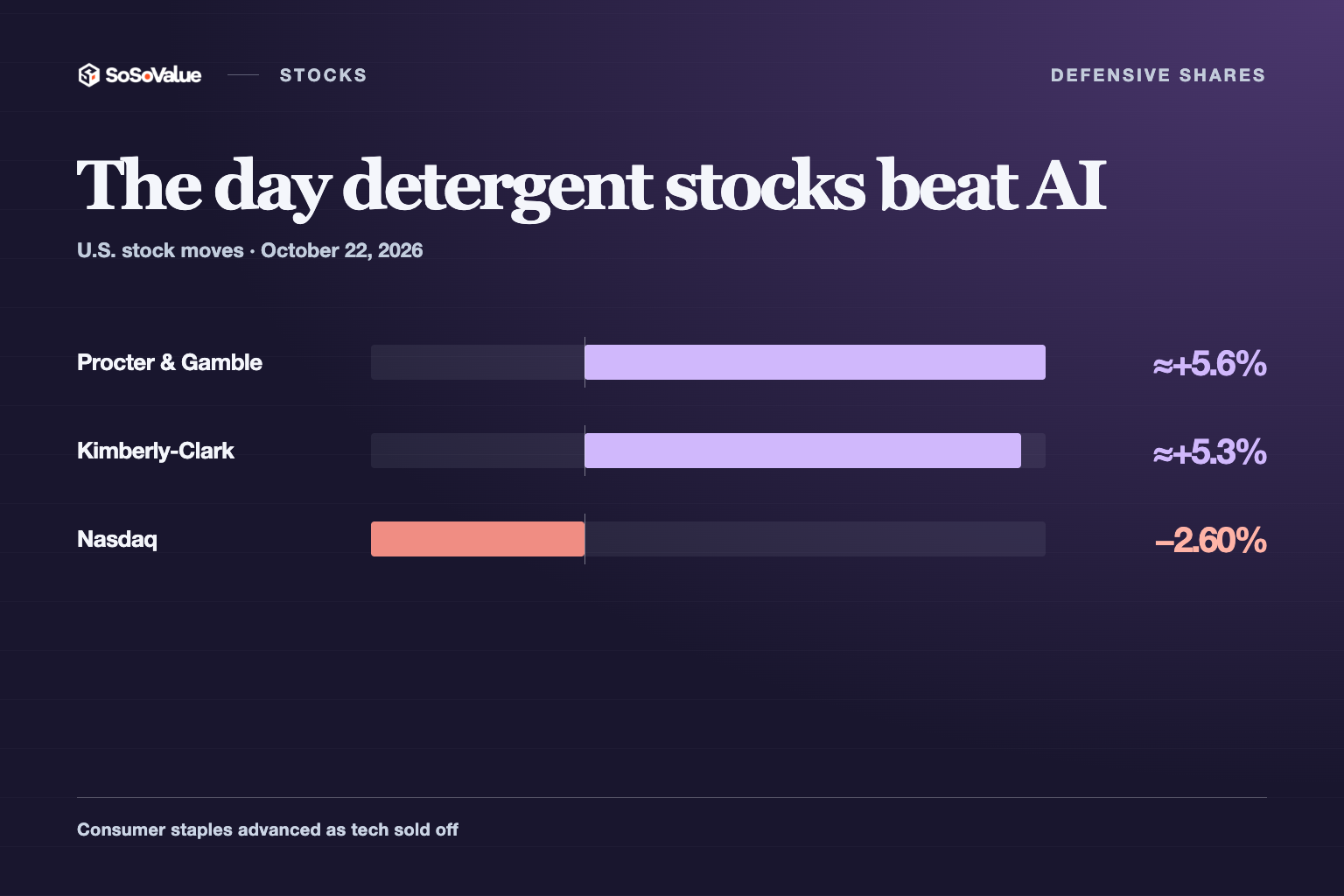
The Nasdaq dropped 2.60% on October 22, 2026. Procter & Gamble gained about 5.6% and Kimberly-Clark rose about 5.3%. Consumer staples have their own volume, pricing and cost risks. Sales of everyday goods can be easier to model through a volatile period than a future return from a data center still under construction.
P&G reported a 4% increase in quarterly net sales and $5.8 billion of operating cash. Dividends and repurchases returned around $3.9 billion to shareholders. That gave investors evidence of the cash available after a normal operating period. Margins still depend on volumes, pricing and input costs. The cash flow comes from goods that customers purchase regularly and from an existing manufacturing network.
Growth and cash returns came apart
Meta’s revenue rose 26% year over year in its latest quarter. Operating cash flow reached $32.79 billion, but capital spending including principal payments on finance leases totaled $34.91 billion, leaving free cash flow negative on the company’s measure. Strong demand for ads still had to finance mounting infrastructure investment.
Meta’s advertising business was growing much faster. The company raised the low end of its full-year capital spending forecast to $135 billion from $130 billion, keeping the high end at $145 billion. As it built or financed new infrastructure, some returns would only become visible in subsequent periods. A shareholder assessing the ad business had to account for the money redirected toward that investment.
The financing risk also varied within AI. Meta had more than $82 billion in cash, cash equivalents and marketable securities at quarter-end, according to the research. An independent compute provider relying on outside financing may have less room for a delay even with contracted demand. A falling index reflected a mix of exposures across those business models.
A rotation has to survive more than one day
One session shows what investors preferred at the prices prevailing that day. A sustained move would need evidence that future AI returns are being pushed out or that defensive firms can keep converting sales into cash. Watch estimates for both sets of companies before drawing a longer-term conclusion.
In a high-rate market, cash generated in the current quarter can receive more weight than a promise of larger cash flows years ahead. The same market can revise that preference when an AI customer pays for new capacity or a staple producer loses volumes. October 22 illustrated a difference in the timing and visibility of returns that could explain the move even as long-run technology demand remained intact.