


What Nvidia’s 12-Times Valuation Measured After Huang Resigned
By Edward Chenug
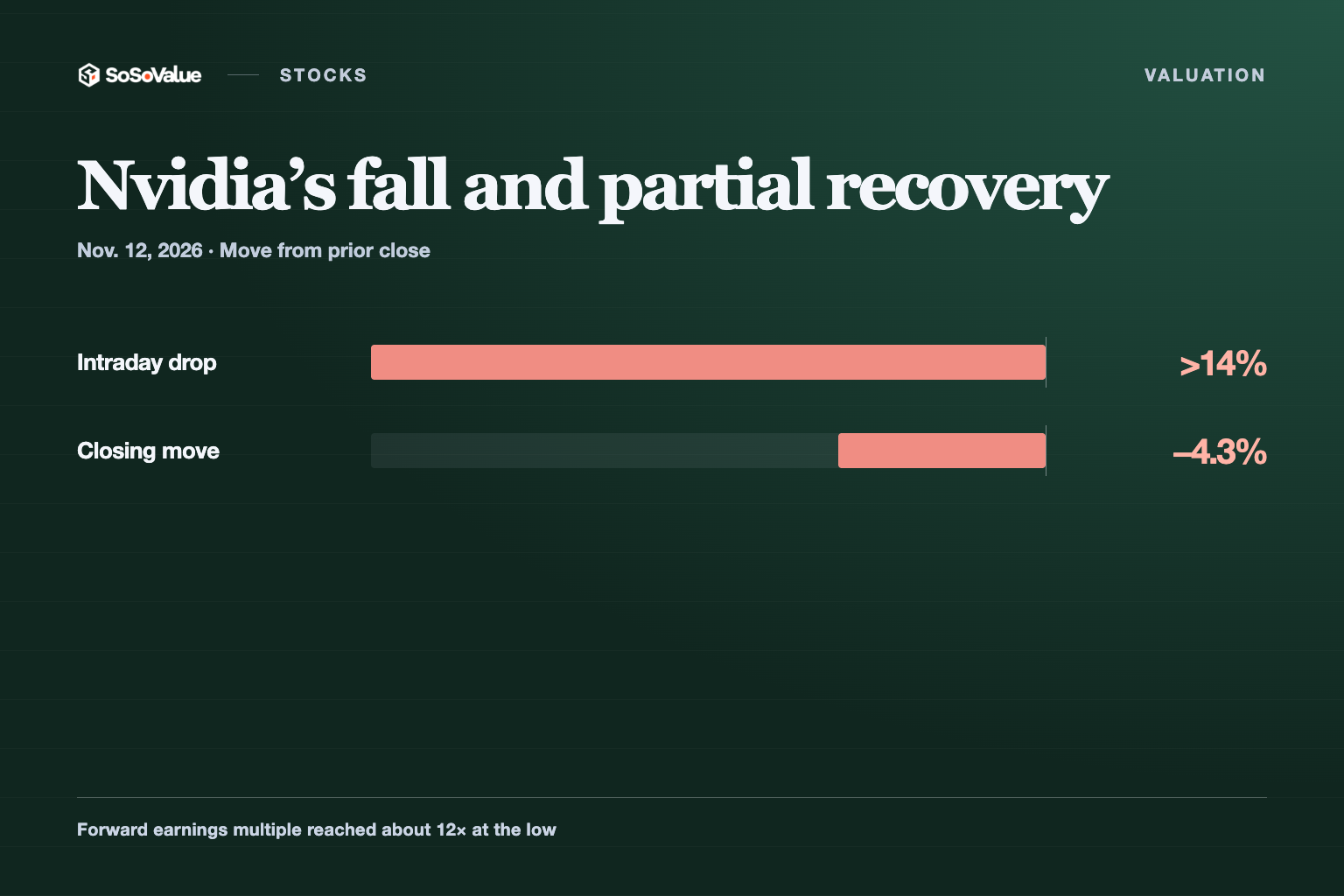
When Nvidia announced Jensen Huang’s resignation on November 12, 2026, buyers and sellers had to decide how much of the company’s earning power depended on its founder. The stock traded briefly near 12 times expected earnings after an early decline of more than 14%. Its subsequent recovery priced in some confidence about continuity while leaving the larger leadership question open.
The rebound set a price for continuity
Nvidia still ended November 12 down 4.3%. The recovery from its low was consistent with investors assigning a larger value to the software ecosystem, validated products and committed orders than the early price implied.
The prior fiscal quarter showed the operating strength the board inherited. Nvidia’s revenue rose 106% from a year earlier and data center revenue grew 117%, with adjusted gross margins near 75%. Customers had already installed systems and built software on its platform. Those economics gave investors a reason to buy into the fall even if they expected more oversight and a slower approval process for some future deals.
Competitors moved differently
AMD and Broadcom gained roughly 5.9% and 5.5%, respectively, while the semiconductor index dipped about 0.5%. The divergence was consistent with investors reassessing who would capture future AI orders. It could also include positioning and short covering, so one session gives limited evidence about durable market-share transfer.
Competitors need customers to act before a rally turns into additional revenue. A buyer might trial a second platform to gain bargaining power while still taking delivery of its Nvidia systems. A durable distribution of market share would require approved designs, software support and repeat purchase commitments. The prices of AMD and Broadcom could react well before those milestones became visible in financial results.
Future commitments can move the denominator
A lower multiple can price uncertainty before forecasts change. If customers pull back orders, tighter guarantees impede financing or export reviews lengthen sales cycles, earnings estimates can fall as well. That would make an apparently low valuation harder to interpret. Watch confirmed orders, supplier commitments and who sets the rules for customer financing.
One source of near-term risk sat in customer financing. Some smaller cloud developers rely on financing and capacity commitments to fund their next purchase. CoreWeave, for example, reported $846 million of net interest expense against $207 million in operating profit in its third quarter. More stringent guarantees could lower Nvidia’s balance-sheet exposure and reduce the pool of that kind of customer demand at the same time.
At the same time, the U.S. ten-year Treasury yield rose to around 5.1%, making new facilities more expensive to finance. The equity multiple just after the resignation reflected the combination of a price drop and forecasts formed under a different leadership and funding backdrop. If estimates came down, a share price that looked inexpensive on the day could imply a higher multiple later. The rebound was an early vote on continuity, with new orders and their financing still to come.