


Why Oracle’s Cash-Flow Timetable Mattered More Than Another AI Growth Figure
By Edward Chenug
Oracle used its October investor day to tell investors when it expected its AI buildout to start producing more cash. Alphabet published its third-quarter results hours later and showed a larger free cash flow deficit. Growth at both companies suggested that buyers wanted more computing power. The day’s trading brought the timing of the outlays and receipts into sharper focus.
Oracle gave investors a milestone
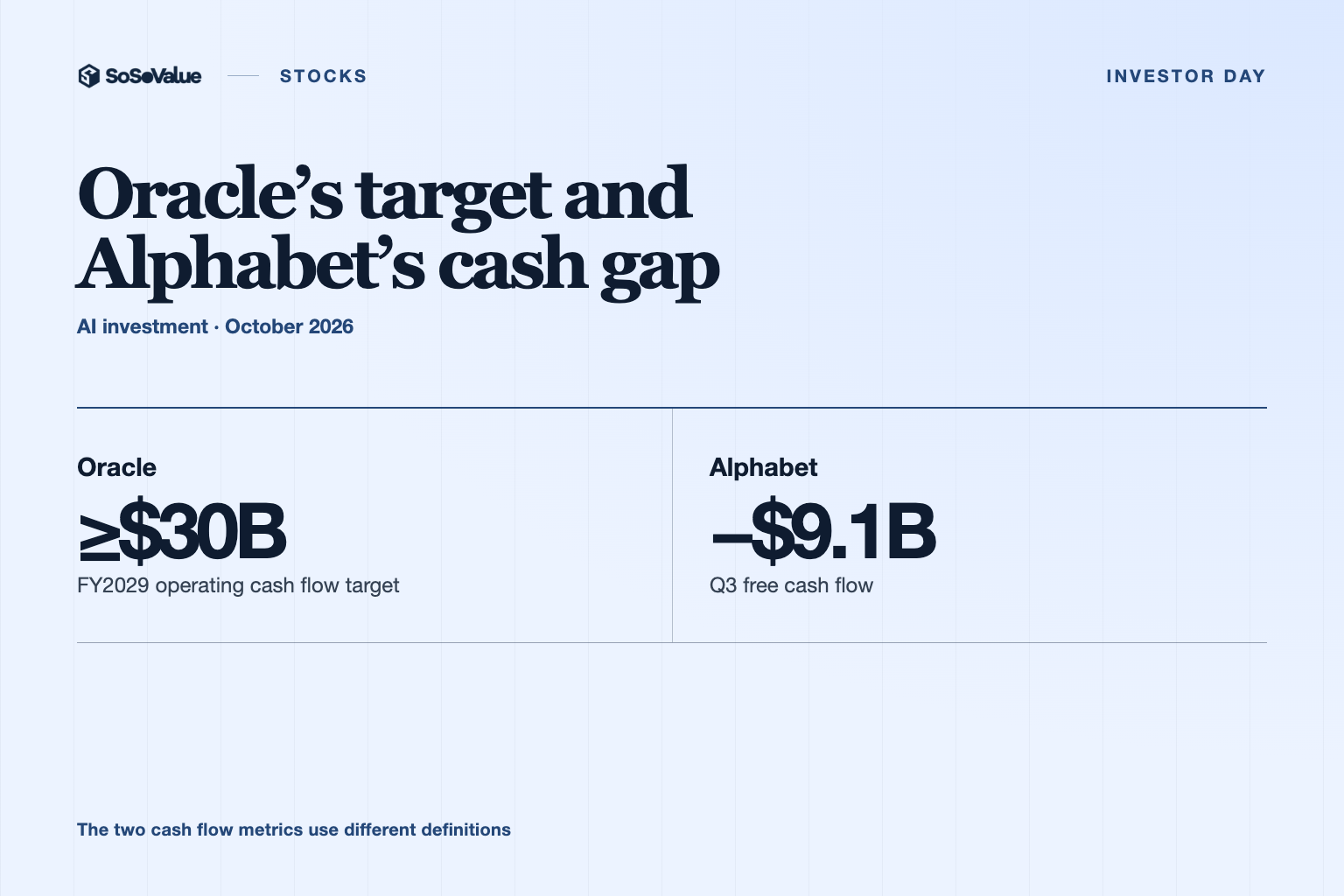
The October investor day put Oracle’s fiscal 2029 operating cash flow target at at least $30 billion and framed financing needs through 2030. Shares rose about 11% on October 28. A dated target lets investors test whether customers start paying for capacity on schedule. It remains a management forecast that will need to be checked against results.
Oracle said it expected spending to peak in fiscal 2027 and 2028 and outlined a period of cash recovery afterward. It put a $20 billion limit on additional capital raising through fiscal 2030, split evenly between debt and equity and excluding refinancing of existing debt. Investors could then set management’s cash target against the dates at which facilities and customer contracts were expected to contribute.
Alphabet showed how large the gap could be
Google Cloud revenue more than doubled year over year, according to the research. At group level, roughly $42.3 billion in operating cash flow fell short of $51.4 billion in purchases of property and equipment. That left a quarterly free cash flow deficit of about $9.1 billion.
Alphabet’s quarterly group revenue rose about 25% year over year, with Cloud revenue of about $30.7 billion. Its free cash flow deficit widened from about $5.9 billion in the prior quarter. The trailing twelve-month measure remained positive at about $19.7 billion, cushioning the immediate cash pressure. A quarterly deficit and a positive trailing figure can coexist as spending ramps over the year.
At the time, management maintained a 2026 capex range of $195 billion to $205 billion and signaled a further increase in 2027. Those commitments mattered because the business had to finance new capacity while it was still collecting cash from prior investments.
Compare like measures
Oracle’s number was a future operating cash flow target. Alphabet’s was a realized free cash flow figure after capital expenditure. The comparison is useful for asking when investment pays back. Any comparison of the companies’ returns needs consistent cash flow definitions and periods.
The comparison is strongest when measured over matching periods. Operating cash flow can improve as new customers are invoiced. Free cash flow also depends on how much the company pays to add capacity in that period. Oracle’s timetable allowed the market to test both assumptions against future releases. Alphabet already had a substantial cash reserve, so its negative quarter focused attention on the scale and duration of spending.