


Robinhood: From Meme-Stock Broker to S&P 500 Financial Super App
Republished by SoSoValue from the SoDEX Research Desk deep dive, originally published on September 9, 2026: https://sodex.com/rwa/robinhood
Key Takeaways
The retail broker that rewrote U.S. brokerage pricing: Robinhood Markets, Inc. (NASDAQ: HOOD) is a Menlo Park–based financial services company founded in 2013 by Vlad Tenev and Baiju Bhatt. It was the first U.S. retail broker to offer commission-free stock trading with no account minimums, and the rest of the industry followed within six years. Tenev is now Chairman and CEO; Bhatt left day-to-day management in March 2024 to found the space-solar startup Aetherflux.
It survived the meme-stock crisis and joined the S&P 500 four years later: In January 2021, Robinhood restricted buying in GameStop and other securities after clearinghouse deposit requirements spiked. It raised roughly $3.4 billion in emergency convertible notes over the following days. The company listed on Nasdaq in July 2021 at $38 per share, fell to an all-time low of $6.81 in June 2022, and was added to the S&P 500 on September 22, 2025.
The business is no longer a single-product trading app: Robinhood now runs brokerage, options, futures, prediction markets, crypto, retirement, advisory, banking, a credit card, and a listed private-markets fund. Management said thirteen separate business lines each exceeded $100 million in annualized revenue as of Q2 2026, up from a handful two years earlier.
Revenue and profit have compounded for three straight years: Total net revenues rose from $1.36 billion in 2022 to $4.47 billion in 2025, and net income swung from a $1.03 billion loss to $1.88 billion of profit over the same period. Q2 2026 revenue reached a record $1.31 billion, up 32% year over year. Net income was $573 million, of which $561 million was attributable to Robinhood, and the adjusted EBITDA margin was 57%.
Prediction markets became the fastest-growing line in the business: Event contract revenue reached $156 million in Q2 2026, more than ten times the prior-year figure, on 13.6 billion contracts traded. In June 2026 Robinhood launched Rothera, a CFTC-licensed exchange and clearinghouse held through a joint venture with Susquehanna International Group, which moves the company from routing event contracts to owning the venue. The legal footing is contested: on August 28, 2026, a unanimous Ninth Circuit panel ruled against Robinhood and Kalshi, holding that sports event contracts are not swaps and that Nevada may regulate them as gambling.
Its own blockchain became an unplanned memecoin venue: Robinhood Chain went live on July 1, 2026, and total value locked reached $909 million by September 5, from $47 million a week after launch. Cumulative decentralized-exchange volume has passed $46 billion. Most of that activity comes from Pons, an independent launchpad Robinhood neither owns nor endorses, and memecoins now trade directly against Robinhood-issued tokenized stocks. On September 2, those stock-paired memecoins traded $217 million against $127 million in the tokenized stocks themselves.
The scale gap with incumbents is still wide: Robinhood held $369 billion of total platform assets across 28.4 million funded customers at the end of Q2 2026. Charles Schwab held $13.1 trillion across 39.8 million active brokerage accounts as of June 30, 2026. Robinhood has a comparable number of accounts and roughly one thirty-fifth of the assets.
Bottom line: Robinhood has converted a controversial trading app into a diversified consumer finance platform with real operating leverage, and the market now capitalizes it at roughly $109 billion, or about 54 times trailing earnings. Four questions remain. Can prediction markets survive state gaming litigation? Will crypto revenue stabilize after two years of decline? How far will interest-rate cuts erode a third of the revenue base? And does the on-chain business survive the end of its gas subsidy on September 29, 2026?
1. Robinhood: An Introduction
Robinhood Markets, Inc. is a U.S. financial services holding company headquartered in Menlo Park, California, and listed on Nasdaq under the ticker HOOD. Its regulated subsidiaries include Robinhood Financial LLC and Robinhood Securities LLC for brokerage, Robinhood Derivatives for futures and event contracts, Robinhood Crypto, Robinhood Money for banking, and Bitstamp for international crypto exchange operations.
The company was founded in 2013 by Vlad Tenev and Baiju Bhatt, two Stanford graduates who had previously built low-latency trading software for institutional clients. Their stated premise was that retail brokerage commissions of roughly $10 per trade were a technological artifact rather than an economic necessity. Robinhood launched commission-free trading with no account minimum, funded the business through payment for order flow and margin lending, and the rest of the U.S. retail brokerage industry followed with zero commissions by late 2019.
Tenev, who describes the company’s goal as "building the Financial SuperApp," serves as Chairman and Chief Executive Officer. Bhatt served as co-CEO until 2020 and as Chief Creative Officer until March 2024, and he remains on the board. Shiv Verma became Chief Financial Officer on February 6, 2026, succeeding Jason Warnick, who had held the role since 2018. Robinhood employed approximately 2,900 full-time staff as of December 31, 2025, and cut roughly 290 roles in June 2026.
📖 Payment for order flow (PFOF): A market maker pays a broker for the right to execute that broker's customer orders. The market maker profits from the bid-ask spread, and the broker is compensated for directing the flow. PFOF is legal in the United States under SEC Rule 606 disclosure requirements and FINRA's best-execution duty. The European Union banned the practice outright with effect from June 30, 2026.
Sources: Robinhood Form 10-K for fiscal year 2025; company press releases (2024–2026); CNBC and Banking Dive coverage (2024–2026).
💡 Why does a retail brokerage app merit a deep dive? Robinhood is the clearest listed proxy for a structural shift in U.S. household finance. Retail investors now account for a materially larger share of equity and options volume than they did a decade ago, and Robinhood sits at the center of that flow. The company is also the first large broker to build a regulated prediction-markets business, which is either a new asset class or a legal liability, depending on how a dozen pending cases resolve.
2. Robinhood's Core Value
To understand Robinhood's value, start with a single fact: before 2013, opening a U.S. brokerage account typically required a minimum balance and a per-trade commission.
The retail brokerage industry has two defining characteristics. First, it is a scale business with brutal fixed costs. Clearing, custody, compliance, and market data are expensive, and they do not shrink when trading volumes fall. Second, it is structurally cyclical. Trading revenue rises with volatility and falls with calm markets, while net interest revenue rises with policy rates and falls when central banks ease.
Robinhood attacked the industry's pricing model rather than its cost structure. The company removed commissions, removed minimums, added fractional shares, and rebuilt the account-opening flow for a smartphone. That combination brought in a customer cohort the incumbents had largely written off: young investors with small balances. Robinhood's average funded account held roughly $13,000 at the end of Q2 2026, against roughly $329,000 for the average Schwab brokerage account. The Schwab figure includes assets custodied for independent advisers, so it flatters the comparison, but the order of magnitude holds.
The strategic bet is that this cohort ages into wealth. Management refers to the "Great Wealth Transfer," the multi-decade handoff of assets from older to younger households. Robinhood's product roadmap since 2022 has been organized around capturing more of each customer's balance sheet before that transfer occurs, through retirement accounts, managed portfolios, banking, credit, and advisory.
📖 Funded customer: Robinhood's headline account metric. It counts a unique person with at least one Robinhood account that either held a positive balance or completed a transaction within the past 45 days. One funded customer may hold several investment accounts.
The near-term value driver is different. Since 2024, Robinhood has added trading products that carry higher revenue per customer than equities: index options, futures, short selling, and event contracts. Options revenue reached $1.12 billion in 2025, and event contract revenue reached $156 million in Q2 2026 alone. Average revenue per user rose 24% year over year to $187 in Q2 2026, while funded customers grew only 7%. Monetization, not customer acquisition, is doing most of the work.
Milestone | Date | Why it matters |
|---|---|---|
First U.S. broker with commission-free trading and no minimums | 2013–2015 | Reset industry pricing; incumbents followed by late 2019 |
GameStop trading restrictions and $3.4 billion emergency raise | Jan–Feb 2021 | Near-death liquidity event; still the source of active litigation and reputational cost |
Nasdaq IPO at $38 per share, roughly $32 billion valuation | Jul 2021 | Public-market debut; stock closed the first day down 8% |
First full year of GAAP profitability | 2024 | $1.41 billion net income after three consecutive loss years |
Added to the S&P 500 | Sep 22, 2025 | Institutional legitimacy and index-fund demand |
Thirteen business lines above $100 million annualized revenue | Q2 2026 | Diversification away from single-product dependence |
Sources: Robinhood Form 10-K for fiscal year 2025; Q2 2026 earnings release; S&P Dow Jones Indices announcement, September 5, 2025.
3. Robinhood's Products and Operations
3.1 Revenue Engines: Three Streams
Robinhood reports revenue in three lines, and the mix has shifted materially over the past two years.
Transaction-based revenues were $2.63 billion in 2025, or 59% of the total. This line is mostly payment for order flow on equities and options, plus commissions on futures and event contracts, plus a fee-based spread on crypto trades.
Net interest revenues were $1.51 billion in 2025, or 34% of the total. The largest components were margin lending at $573 million, interest on segregated customer cash at $319 million, the cash sweep program at $229 million, and securities lending at $190 million. This line is directly exposed to Federal Reserve policy, and the 10-K states plainly that further rate cuts will reduce it.
Other revenues were $331 million in 2025, or 7% of the total. Robinhood Gold subscription fees contributed $179 million, and proxy services contributed $63 million.
Revenue source | 2023 | 2024 | 2025 |
|---|---|---|---|
Options | $505M | $760M | $1,123M |
Cryptocurrencies | $135M | $626M | $901M |
Equities | $104M | $177M | $302M |
Other transaction (incl. event contracts) | $41M | $84M | $302M |
Total transaction-based | $785M | $1,647M | $2,628M |
Net interest revenues | $929M | $1,109M | $1,514M |
Other revenues | $151M | $195M | $331M |
Total net revenues | $1,865M | $2,951M | $4,473M |
Sources: Robinhood Form 10-K for fiscal year 2025, Note 5.
What this means: The 2024 revenue surge was a crypto story, with cryptocurrency revenue rising 364% in a single year. The 2026 story is the opposite. Crypto revenue fell 38% year over year in Q2 2026 to $100 million, while event contracts, options, and equities more than absorbed the decline. Robinhood has replaced one volatile revenue source with another, but it now has four meaningful transaction lines rather than two.
3.2 Product Line
Product | Status | Key metrics |
|---|---|---|
Equities and options | Core business since 2013 and 2017 | Q2 2026: $956B equity notional volume, up 85%; 774M options contracts, up 50% |
Prediction markets | Event contracts launched 2024; Prediction Markets Hub launched March 2025; Rothera exchange launched June 2026 | Q2 2026: 13.6B event contracts traded, more than 10x year over year; $156M revenue |
Cryptocurrency | Robinhood Crypto in the U.S.; Bitstamp internationally since June 2025 | Q2 2026: $40B notional, of which Bitstamp was $22B; app volume down 35% |
Robinhood Gold | $5 per month subscription | 4.8M subscribers at Q2 2026, up 39%; 17% adoption rate |
Robinhood Gold Card | Credit card issued with Coastal Bank | Over 1M customers; roughly $17B annualized purchase volume |
Robinhood Retirement | Traditional and Roth IRAs with a contribution match | $34.5B assets under custody at Q2 2026, up 82% |
Robinhood Banking | Rolled out to Gold subscribers from late 2025 | Over $3B deposits from over 240,000 funded customers |
Robinhood Strategies / TradePMR | Managed portfolios and RIA custody | Strategies: 300,000+ customers, nearly $2B AUM; TradePMR: $50B AUM |
Trump Accounts | Launched July 4, 2026; Robinhood is broker and sole initial trustee | Over 7M sign-ups; nearly $1.5B deposited |
Robinhood Ventures Fund I (RVI) | NYSE-listed closed-end fund holding private companies; IPO March 5, 2026 | Deconsolidated in Q2 2026, producing a $129M gain |
Robinhood Chain | Arbitrum-stack Ethereum Layer 2; public mainnet July 1, 2026 | $909M TVL and $46B cumulative DEX volume by early September 2026 |
Stock Tokens | ERC-20 debt securities issued by Robinhood Assets (Jersey) Limited | 190+ tokens live in 120+ countries; not offered to U.S. persons |
Agentic Trading | AI-driven trading agents, launched May 2026 | Nearly 100,000 accounts; over $100M assets under custody |
Sources: Robinhood Q1 2026 and Q2 2026 earnings releases; Form 10-K for fiscal year 2025.
What this means: Robinhood ships product faster than any listed competitor of comparable size, and the pace is now the explicit strategy. The risk is dilution of focus. Trump Accounts, a Layer 2 blockchain, a closed-end fund, a credit card, and a CFTC-licensed exchange are five different regulatory regimes, and each carries its own compliance burden.
3.3 Customers and Scale
Robinhood ended Q2 2026 with 28.4 million funded customers, up 7% year over year, and 29.9 million investment accounts. Total platform assets reached $369 billion, up 32%. Net deposits were $21.7 billion in the quarter, an annualized growth rate of 28% against the prior quarter's asset base, and $75.7 billion over the trailing twelve months.
Two figures deserve attention. First, deposit growth is running roughly four times faster than customer growth, which confirms that existing customers are consolidating more of their assets onto the platform. Second, the margin book reached $21.6 billion, up 127% year over year, which is the single largest driver of net interest revenue and also the largest source of credit risk.
International expansion accelerated in 2025 and 2026. Robinhood acquired Bitstamp for approximately $224 million in June 2025, closed the acquisition of Canadian digital-asset firm WonderFi in June 2026, and passed one million international funded customers during Q2 2026. Robinhood Singapore received a capital markets services license from the Monetary Authority of Singapore on July 1, 2026.
Sources: Robinhood Q2 2026 earnings release; Form 10-K for fiscal year 2025, Note 3.
3.4 Robinhood Chain: The On-Chain Leg
Robinhood Chain is the most consequential product Robinhood has shipped since prediction markets, and it is the one least visible in the financial statements. The public mainnet went live on July 1, 2026. It is an Ethereum Layer 2 built on the Arbitrum stack, it uses ETH for gas, and Robinhood operates the sequencer. Under the Arbitrum Expansion Program, 10% of net sequencer revenue is shared with the Arbitrum ecosystem, split between the DAO treasury and a developer guild.
Robinhood designed the chain for tokenized real-world assets. What actually filled it was memecoins.
Stock Tokens: the intended use case. Robinhood Assets (Jersey) Limited issues Stock Tokens as ERC-20 debt securities that track listed equities and ETFs. Holders receive economic exposure, not shareholder rights. More than 190 Stock Tokens are live, and the product is offered in over 120 countries through Robinhood Wallet. It is explicitly not offered to U.S. persons under Regulation S, and it is restricted in Canada, the United Kingdom, and Switzerland. New supply can be minted only by a KYB-approved authorized participant. Secondary trading, by contrast, is fully permissionless.
That asymmetry — gated minting, ungated trading — is the design decision that produced everything below.
Pons: the unintended use case. Pons is a token launchpad that went live on July 13, 2026, twelve days after mainnet. A user supplies a name, a ticker, and an image; the platform deploys a fixed one-billion-supply token straight into a trading pool for a launch fee of roughly one dollar, tradable from the first block. Pons is operated by Pons Labs, LLC. It is not a Robinhood product, it is not affiliated with Robinhood Markets, and its presence on the chain implies no endorsement. This distinction matters for reading the revenue, and several press accounts have blurred it.
On-chain scale as of early September 2026:
Metric | Value | As of |
|---|---|---|
Chain total value locked (TVL) | $908.7M | Sep 5, 2026 |
Chain TVL one month earlier | $429.8M | Aug 5, 2026 |
Chain TVL one week after launch | $46.8M | Jul 7, 2026 |
Cumulative DEX volume | $46.0B | Sep 6, 2026 |
Trailing 30-day DEX volume | $24.1B | Sep 6, 2026 |
24-hour DEX volume | $1.61B | Sep 6, 2026 |
Chain fees, all-time | $32.0M | Sep 6, 2026 |
Chain revenue, all-time | $28.7M | Sep 6, 2026 |
Pons fees, trailing 24 hours (V1 and V2) | $9.05M | Sep 6, 2026 |
Pons fees, all-time (V1 and V2) | $72.5M | Sep 6, 2026 |
PONS token market capitalization | $616M | Sep 6, 2026 |
Sources: DefiLlama chain, fee, revenue, and DEX endpoints, queried September 6, 2026; CoinGecko, September 6, 2026.
Locked capital is concentrated in a small number of protocols. Morpho Blue holds roughly $519 million of lending TVL, Uniswap V4 and V3 hold roughly $161 million and $81 million respectively, and Lighter's perpetuals venue holds roughly $65 million. Uniswap V4 clears the large majority of DEX volume, because Pons tokens graduate from their launch curve onto Uniswap.
The stock-meme linkage. The genuine innovation is not that memecoins launched on a broker's blockchain. It is that they began trading directly against tokenized equities. Because Stock Tokens are ordinary ERC-20 assets, any pool can quote a memecoin against NVDA, TSLA, AAPL, or HIMS exposure. Named pairs include BONER against HIMS, Artificial Inu against NVDA, Gently Used Tesla against TSLA, and Stonks against SPY. On September 2, memecoins paired against Stock Tokens traded $217 million, against $127 million in direct Stock Token markets on the same day. The speculative wrapper is now doing more volume than the underlying product.
⚠ ️ The HIMS squeeze — what gated minting does under stress. In one documented episode, the BONER token's liquidity pool accumulated 53.1% of all circulating tokenized HIMS, or 31,198 of 58,714 tokens. With the underlying U.S. market closed over a weekend and no participant able to mint fresh supply, the tokenized HIMS price reached $132.64 against a $28.84 stock close, a premium of roughly 4.6 times. The dislocation only normalized after the market reopened and roughly 4,000 new tokens were minted. Permissionless trading on top of gated supply can manufacture a scarcity event in a security-linked instrument, and Robinhood's own filings warn that such third-party activity may be difficult or impossible to monitor, influence, or prevent.
What Robinhood actually earns. This is where press coverage has been loosest. Pons collected roughly $9.05 million of fees in a single day in early September, and headlines framed that as Robinhood revenue. It is not. Pons fees accrue to Pons Labs and to token creators. Robinhood's economics come from the chain itself: sequencer fees of roughly $32.0 million and chain revenue of roughly $28.7 million since launch, before the 10% shared with Arbitrum. Against $4.47 billion of 2025 group revenue, that figure is immaterial today. Its significance is as an option, not as an earnings contribution.
Two live tests. First, Robinhood subsidized gas for eligible Robinhood Wallet transactions for the first 90 days, and that subsidy is scheduled to expire on September 29, 2026. Activity from October onward will be the first clean read on organic demand. Second, Vlad Tenev has floated airdropping Stock Tokens to memecoin holders, which would formalize the crypto-to-equities bridge that traders built on their own. That mechanism remains in design, has no announced timeline, and faces obvious securities-law obstacles.
Sources: Robinhood Chain documentation; CryptoSlate, CoinDesk, and Yahoo Finance coverage (September 2026); DefiLlama and CoinGecko (September 6, 2026).
4. Robinhood's Moat
Brand and cohort ownership: Robinhood is the default brokerage brand for U.S. investors who began investing after 2015. That position was expensive to build and would be expensive to displace. Customer acquisition cost is structurally lower for Robinhood than for incumbents targeting the same demographic.
Product velocity as a competitive weapon: Robinhood shipped index options, futures, short selling, prediction markets, a credit card, banking, managed portfolios, a Layer 2 blockchain, and AI trading agents within roughly twenty-four months. Schwab and Fidelity operate on multi-year release cycles constrained by legacy infrastructure. Speed is a genuine structural advantage in a market where retail preferences move quickly.
Vertical integration into market structure: The Rothera joint venture with Susquehanna International Group gives Robinhood an ownership position in a CFTC-licensed exchange and clearinghouse. Owning the venue captures exchange economics rather than paying them away, and it reduces dependence on third-party platforms such as Kalshi.
Regulatory licenses as a barrier: Robinhood holds broker-dealer, futures commission merchant, state money transmitter, UK FCA, EU, and now Singapore licenses. New entrants must replicate that stack before competing at scale, and the process takes years.
Structural operating leverage: Adjusted EBITDA margin reached 57% in Q2 2026, and total operating expenses ran at 56% of revenue. Robinhood's fixed cost base is largely technology and compliance, so incremental trading volume flows to profit at a very high rate.
Sources: Robinhood Form 10-K for fiscal year 2025; Q2 2026 earnings release; company press releases (2025–2026).
⚠ ️ The honest caveat: Robinhood's advantage is speed and brand, not proprietary technology or a structural cost edge. Payment for order flow, the mechanism that made zero-commission trading viable, depends on a U.S. regulatory posture that could change. The European Union banned the practice with effect from June 30, 2026, and U.S. regulators have examined it repeatedly since 2021. A U.S. ban would not be fatal, because roughly a third of revenue is interest income and a growing share is subscriptions and commissions, but it would remove the mechanism the whole model was built on.
5. Robinhood's Commercialization and Capital
Robinhood's financial history divides cleanly into two phases: three years of heavy losses following the 2021 IPO, then three years of accelerating profitability. The figures below are drawn from the company's SEC filings.
Financial snapshot (in millions USD):
Item | 2021 | 2022 | 2023 | 2024 | 2025 | H1 2026 |
|---|---|---|---|---|---|---|
Total net revenues | 1,815 | 1,358 | 1,865 | 2,951 | 4,473 | 2,375 |
Net income (loss) | (3,687) | (1,028) | (541) | 1,411 | 1,883 | 919 |
Diluted EPS | — | — | — | $1.56 | $2.05 | $1.00 |
Adjusted EBITDA | — | — | — | ~1,416 | ~2,505 | 1,275 |
Adjusted EBITDA margin | — | — | — | 48% | 56% | 54% |
Note: The 2021 loss was driven largely by share-based compensation recognized at the IPO. The 2024 result included a $424 million benefit that the company attributes to a fourth-quarter tax benefit and a regulatory accrual reversal.
Quarterly revenue trajectory (USD millions):
Quarter | Total net revenues |
|---|---|
Q1 2025 | 927 |
Q2 2025 | 989 |
Q3 2025 | 1,274 |
Q4 2025 | 1,283 |
Q1 2026 | 1,067 |
Q2 2026 | 1,308 |
Sources: Robinhood quarterly earnings releases (2025–2026); Form 10-K for fiscal year 2025.
Four aspects stand out:
From structural losses to sector-leading margins: Robinhood lost $5.26 billion in aggregate across 2021 to 2023. It then earned $4.21 billion across 2024, 2025, and the first half of 2026. Accumulated deficit fell from $2.15 billion at the end of 2025 to $1.24 billion on June 30, 2026. At the Q2 2026 earnings rate, the remaining deficit would be eliminated within roughly two more quarters.
Revenue growth is broad rather than concentrated: Q2 2026 revenue grew 32% year over year even as cryptocurrency revenue fell 38%. Event contracts, options, equities, and subscription revenue each contributed. In 2024, by contrast, a single asset class drove most of the growth.
Cash generation is strong but noisy: Operating cash flow was $2.76 billion in the first half of 2026. Broker-dealer cash flows swing sharply with customer balances and securities lending activity, so the figure should not be read as free cash flow. Cash and cash equivalents stood at $5.36 billion at June 30, 2026, including proceeds from a $2.2 billion convertible note offering completed in June 2026.
Capital returns have begun: Robinhood has repurchased $1.3 billion of Class A stock since the program started in Q3 2024, at an average price of roughly $47 per share against a current price near $122. The board refreshed the authorization to $1.5 billion in March 2026. The company pays no dividend.
Sources: Robinhood Q2 2026 earnings release; Form 10-K for fiscal year 2025.
📅 Funding History and Valuation Trajectory
Date | Round | Amount | Investors and valuation anchors |
|---|---|---|---|
Sep 2026 | Public market | — | Roughly $109 billion market capitalization at $121.72 per share |
Jul 2021 | Nasdaq IPO | ~$2.1B | 55 million shares at $38.00; approximately $32 billion valuation; closed first day at $34.82 |
Jan–Feb 2021 | Emergency convertible notes | ~$3.4B | Existing investors; raised during the GameStop clearing crisis |
Sep 2020 | Series G extension | ~$460M | Post-money valuation reported at approximately $11.7 billion |
Aug 2020 | Series G | $200M | D1 Capital Partners; valuation reported at $11.2 billion |
Jul 2019 | Series E | $323M | DST Global, Ribbit Capital, NEA, Sequoia, Thrive Capital; valuation reported at $7.6 billion |
Feb 2018 | Series D | $363M | DST Global |
Sources: CNBC, Fox Business, The Washington Post (2020–2021); Robinhood newsroom; stockanalysis.com (September 4, 2026). Private-round valuations are as reported by media at the time.
Ownership and control. Robinhood operates a dual-class structure. As of June 30, 2026, there were 790 million Class A shares and 109 million Class B shares outstanding. Class B carries superior voting rights and is held principally by the founders, which concentrates control with Vlad Tenev notwithstanding a modest economic stake. Institutional ownership rose sharply after the September 2025 S&P 500 inclusion, because index funds were required to buy.
How to think about the valuation:
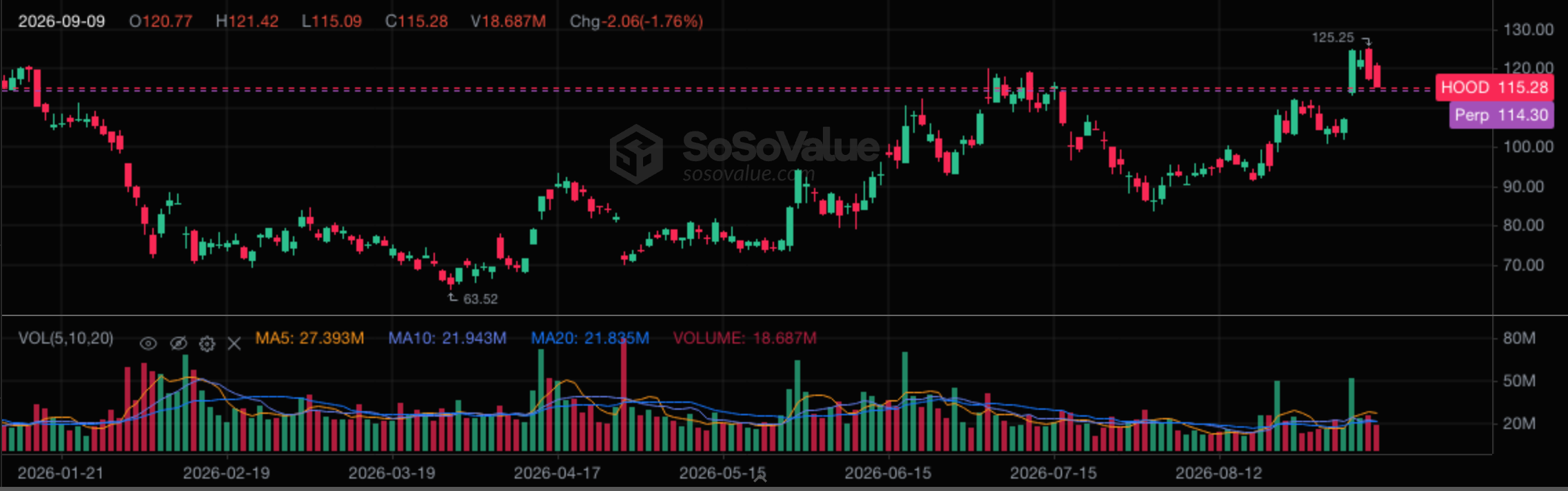
HOOD daily candles through September 9, 2026 — last close $115.28, 52-week range $63.52 to $153.86. Source: SoSoValue.
Valuation basis | Implied value | Operational nature and market context |
|---|---|---|
Nasdaq IPO (July 2021) | ~$32B | Actual primary transaction; the anchor the market spent four years re-rating |
All-time low (June 2022) | ~$6B | Trough valuation at $6.81 per share, during the post-meme-stock unwind |
Current market (Sep 4, 2026) | ~$109B | $121.72 per share; trailing P/E of approximately 54 |
52-week high | ~$138B | $153.86 per share, reached earlier in the current cycle |
⚠ ️ Strategic boundary note: Between the $6 billion trough of June 2022 and the $138 billion peak of the past twelve months lies an entire retail-trading cycle plus a substantial amount of market imagination. At roughly 54 times trailing earnings, Robinhood trades at approximately 2.7 times Charles Schwab's multiple. That premium prices in continued execution on prediction markets, banking, and international expansion. It is a scenario, not a verdict.
6. Robinhood's Breakout Moments
The through-line: Robinhood evolved from a pricing insurgent into a full-stack consumer finance platform, and within the current retail-trading boom, into an index-constituent large cap.
2013–2015 | The zero-commission breakthrough (Menlo Park). Robinhood launched commission-free equity trading with no account minimum, funded by payment for order flow and margin lending. Schwab, TD Ameritrade, E*TRADE, and Fidelity all eliminated U.S. equity commissions by October 2019.
January–February 2021 | The GameStop crisis. The National Securities Clearing Corporation raised Robinhood's deposit requirements during extreme volatility in GameStop and AMC. Robinhood restricted purchases of the affected securities and drew roughly $3.4 billion in emergency convertible financing. The episode produced congressional testimony, dozens of lawsuits, and multiple regulatory investigations. Most of the resulting private litigation has since been dismissed or settled.
July 29, 2021 | Nasdaq IPO. Robinhood priced 55 million shares at $38.00, the bottom of its range, raising more than $2 billion at roughly a $32 billion valuation. The stock closed its first session down 8% at $34.82.
2024 | First profitable year. Robinhood reported $2.95 billion of revenue and $1.41 billion of net income, its first full-year GAAP profit. The result was helped by a $424 million tax and accrual benefit, but the underlying business had turned.
September 22, 2025 | S&P 500 inclusion. S&P Dow Jones Indices added Robinhood to the S&P 500 alongside AppLovin and Emcor Group. The addition completed the company's institutional rehabilitation four years after the IPO, and it forced index funds into the stock.
June 2026 | Rothera and Robinhood Chain. Robinhood launched Rothera, a CFTC-licensed exchange and clearinghouse operated through its joint venture with Susquehanna International Group. In the same month, the company unveiled the Robinhood Chain public mainnet at an event in London, alongside Stock Tokens for users in more than 120 countries. The chain itself went live on July 1, 2026. Both moves push Robinhood from distribution into market infrastructure.
July–September 2026 | Robinhood Chain finds an unintended product-market fit. Robinhood Chain went live on July 1, 2026 as an Arbitrum-stack Layer 2 intended for tokenized real-world assets. Within ten weeks, total value locked climbed from under $50 million to roughly $909 million, and cumulative decentralized-exchange volume passed $46 billion. The driver was not tokenized equities but Pons, an independent memecoin launchpad that opened on July 13 and briefly ranked among the largest fee-generating protocols in crypto. Traders then began quoting those memecoins directly against Robinhood-issued Stock Tokens, creating a linkage the company did not design.
July 4, 2026 | Trump Accounts launch. Robinhood became the broker and sole initial trustee for Trump Accounts, the federal savings program for U.S. minors, working alongside BNY. More than seven million accounts were opened within roughly three weeks, with nearly $1.5 billion deposited. The program delivers a customer cohort of children who will hold Robinhood accounts for decades.
Sources: Robinhood earnings releases (2024–2026); Robinhood newsroom (2026); CNBC (2021, 2025, 2026); S&P Dow Jones Indices (September 2025); DefiLlama (September 6, 2026).
7. Robinhood's Industry
The U.S. retail brokerage industry is defined by three structural pillars.
Zero commissions and a shift to balance-sheet economics. Once commissions went to zero across the industry in 2019, brokers came to depend on order-flow payments, net interest on customer cash and margin loans, securities lending, and subscriptions. That change made retail brokerage far more sensitive to interest rates than it had been, and it tied broker profitability to the Federal Reserve.
Extreme cyclicality in transaction revenue. Trading revenue rises with volatility and retail participation, and it falls when markets are quiet. The 2021 meme-stock episode was followed by a sharp 2022 contraction in which Robinhood's revenue fell 25%. The 2024–2026 crypto and options boom is the mirror image. Every broker's transaction line is a cyclical asset.
The rise of new retail asset classes. Options, futures, crypto, and now event contracts have grown far faster than cash equities. Citadel Securities reported that retail traded a record $6.8 billion of options premium per day in June 2026, roughly 65% above the 2025 average, and that nearly half of retail options volume now trades in zero-days-to-expiry contracts. Prediction-market volumes across the industry scaled from under $5 billion per month in September 2025 to roughly $21 billion to $24 billion per month by mid-2026.
📖 Event contract: A regulated derivative that pays $1 if a specified real-world event occurs and nothing if it does not. Contracts trade in one-cent increments between $0.00 and $1.00, so the price functions as a market-implied probability. In the United States, event contracts are regulated by the CFTC. Whether that federal regime displaces state gaming law is now the subject of a live circuit split.
8. Key Stats
Metric | Size | Period |
|---|---|---|
Charles Schwab total client assets | $13.1 trillion | Q2 2026 |
Schwab active brokerage accounts | 39.8 million | Q2 2026 |
Robinhood total platform assets | $369 billion | Q2 2026 |
Robinhood funded customers | 28.4 million | Q2 2026 |
Industry prediction-market monthly volume | ~$21 billion | 2026 (reported) |
Robinhood event contracts traded | 13.6 billion | Q2 2026 |
Citadel Securities share of U.S. retail volume | ~35% | 2026 |
Note: Schwab client assets include Advisor Services balances custodied for independent RIAs, so the comparison with Robinhood's platform assets is directional rather than exact.
Source: Charles Schwab monthly activity releases; Robinhood Q2 2026 earnings release; Citadel Securities market-structure commentary (2026).
What this means — two key judgments:
The account base is already at incumbent scale; the asset base is not. Robinhood has 71% as many funded customers as Schwab has active brokerage accounts, and 2.8% of Schwab's client assets. If Robinhood's average account balance were to rise from roughly $13,000 to even $50,000, platform assets would exceed $1.4 trillion without a single new customer. That arithmetic is the entire long-term bull case.
Prediction markets are a genuinely new pool, and Robinhood is early. Event contracts contributed roughly 12% of Q2 2026 revenue from a standing start two years ago. No incumbent broker of comparable size offers the product at scale. The category is growing faster than any other retail asset class, and Robinhood now owns exchange infrastructure through Rothera.
The structural rate kicker cuts both ways: Roughly a third of Robinhood's revenue is net interest income, and the 10-K states that further Federal Reserve rate cuts will reduce it. A rate-cutting cycle would compress this line even as it stimulates trading activity. The two effects partially offset, but the net direction is unfavorable.
9. What Comes Next For Robinhood
Defending prediction markets at the Supreme Court. The decisive question is legal rather than commercial, and it is now squarely before the courts. On April 6, 2026, a divided Third Circuit panel held in KalshiEX LLC v. Flaherty that sports event contracts are swaps under the Commodity Exchange Act and that federal law preempts state gambling regulation. On August 28, 2026, a unanimous Ninth Circuit panel held the opposite, ruling that such contracts are not swaps and that Nevada may enforce its gaming laws. Robinhood Derivatives was a named appellant and lost. That split makes Supreme Court review likely. Robinhood says it intends to appeal, and it separately faces suits from state gambling-recovery entities in six states, from three California tribes and the Ho-Chunk Nation under RICO, and from regulators in New Jersey and Massachusetts.
Converting Trump Accounts into lifetime customers. More than seven million accounts arrived in a matter of weeks at near-zero acquisition cost. Robinhood earns service revenue on the program today, but the strategic value is the pipeline: a generation of customers who hold a Robinhood account from birth.
Scaling banking and advisory to change the asset mix. Robinhood Banking held over $3 billion of deposits and Robinhood Strategies held nearly $2 billion of AUM at Q2 2026. These are small numbers against $369 billion of platform assets, but they are the products most likely to lift the average account balance and reduce dependence on trading volumes.
Building out international and tokenized markets. Bitstamp, WonderFi, the UK crypto launch, EU perpetual futures, Stock Tokens in more than 120 countries, and the Singapore license together form a second growth vector. It is largely independent of the U.S. trading cycle. Execution here is unproven, and international revenue remains a small share of the total.
Proving that Robinhood Chain has organic demand. The 90-day gas subsidy covering eligible Robinhood Wallet transactions expires on September 29, 2026. From October, users pay their own transaction costs for the first time. Chain fees have run at roughly $32 million since launch, which is immaterial against group revenue, so the near-term question is not earnings but retention. A durable chain gives Robinhood a settlement layer it controls; a subsidy-dependent one gives it a marketing expense.
Managing the rate cycle. Net interest revenue grew only 9% year over year in Q2 2026, against 44% growth in transaction revenue. Margin lending is now the offset: the margin book more than doubled to $21.6 billion, which supports the interest line but also raises credit exposure in a market drawdown.
10. Competitive Landscape
Company | Focus | FY2025 revenue | Market cap (Sep 4, 2026) | Scale metric |
|---|---|---|---|---|
Charles Schwab | Full-service brokerage, custody, banking | $23.9B | ~$188B | $13.1T client assets |
Robinhood | Retail brokerage, crypto, prediction markets | $4.47B | ~$109B | $369B platform assets |
Interactive Brokers | Global electronic brokerage | $6.2B | ~$42B (public entity) | 5.32M customer accounts |
Coinbase | Crypto exchange and infrastructure | $7.0B | ~$49B | Crypto-only |
Note: Interactive Brokers Group, Inc. holds a minority economic interest in the operating partnership, so its listed market capitalization understates enterprise value. All market data as of September 4, 2026.
Sources: Company earnings releases (2025–2026); stockanalysis.com (September 4, 2026).
Among this peer set, Robinhood ranks fourth by revenue and second by market capitalization. Four reference points are worth singling out.
Charles Schwab (the asset-gathering benchmark). Schwab earns roughly five times Robinhood's revenue from thirty-five times the assets, and it trades at roughly 20 times earnings. The comparison shows what Robinhood's model would look like at maturity, and it also shows how much of Robinhood's current price is growth expectation rather than earnings.
Interactive Brokers (the execution benchmark). IBKR serves sophisticated and international traders with lower per-trade economics and a leaner cost structure. Its customer accounts grew 34% year over year in July 2026, faster than Robinhood's 7%, from a much smaller base. IBKR is the clearest competitor for Robinhood's active-trader cohort.
Coinbase (the cautionary comparison). Coinbase generated $7.0 billion of revenue in 2025 but reported a trailing-twelve-month net loss as of September 2026, and its market capitalization has contracted sharply over the past year. Coinbase demonstrates what happens to a platform that remains dependent on a single volatile asset class. Robinhood's diversification since 2024 is a direct answer to that risk.
Kalshi and Polymarket (partner and rival). Robinhood's Prediction Markets Hub launched by routing to Kalshi, and industry coverage indicates Robinhood came to supply a majority of Kalshi's volume. The Rothera joint venture converts that dependence into ownership. Robinhood is now simultaneously Kalshi's largest distribution partner and the operator of a competing venue.
🎯 The bottom line on Robinhood's positioning
Robinhood's thesis reduces to one line: it owns the next generation of U.S. retail investors, and it is now selling them higher-margin products faster than any competitor can respond.
Robinhood does not need to beat Schwab on assets. Raising the average balance of the customers it already has, while monetizing them through options, event contracts, subscriptions, and credit, supports several multiples of current revenue. That is a genuine structural advantage, and no incumbent has an obvious answer to it.
11. Robinhood's Risks and Challenges
⚠ ️ Significant downside risks and structural vulnerabilities
Prediction-markets legal risk — no longer hypothetical. On August 28, 2026, a unanimous Ninth Circuit panel ruled that sports event contracts are not swaps under the Commodity Exchange Act, and that Nevada may therefore apply its gaming laws to them. Robinhood Derivatives was a named appellant alongside KalshiEX and the North American Derivatives Exchange, and the panel affirmed the dissolution of the injunction that had held Nevada off. A Robinhood spokesperson said the company disagrees and intends to appeal. The decision squarely contradicts the Third Circuit's April 6, 2026 ruling in KalshiEX LLC v. Flaherty, and that split points toward Supreme Court review. Robinhood separately faces parallel litigation in at least ten jurisdictions asserting that event contracts constitute unlawful gambling, brought by state gambling-recovery entities, three California tribes, and the Ho-Chunk Nation, several of them under civil RICO. The 10-K states explicitly that regulatory enforcement or a change in federal or state law could prevent Robinhood from offering event contracts at all. That line contributed roughly 12% of Q2 2026 revenue.
Cycle risk — the most certain. Transaction revenue depends on retail trading volumes, which are at record levels. Equity notional volumes rose 85% year over year in Q2 2026, and options contracts rose 50%. Those comparisons become punishing in any market drawdown. Robinhood's revenue fell 25% in 2022 for exactly this reason.
Interest-rate exposure. Net interest revenue was 34% of 2025 revenue and grew only 9% year over year in Q2 2026. The 10-K warns that further Fed rate cuts will reduce this line and also reduce customer returns on cash, which affects deposit gathering. Cash sweep balances have already declined 9% year over year.
Payment for order flow. The EU ban took effect on June 30, 2026, and U.S. regulators have examined the practice repeatedly. Robinhood identifies PFOF regulation as a principal risk factor in its own filings. A U.S. restriction would force a pricing model change across the equities and options business.
Crypto revenue decline. Cryptocurrency revenue fell 38% year over year in Q2 2026 and 47% in Q1 2026. Robinhood app crypto notional volume fell 35% year over year. Bitstamp partially offsets the decline, but a sustained crypto downturn removes what was the largest single growth driver of 2024.
Tokenized equities and third-party on-chain activity. Stock Tokens are unregistered under U.S. securities law and are sold only outside the United States under Regulation S, which limits legal exposure but not reputational exposure. On September 4, 2026, AMC Entertainment’s chief executive publicly demanded that Robinhood stop trading AMC-linked tokens and said the company would engage outside securities counsel; Robinhood declined. Separately, gated minting combined with permissionless secondary trading has already produced at least one documented price dislocation, when tokenized HIMS traded at roughly 4.6 times its underlying close during a weekend squeeze. Robinhood’s filings warn that third-party on-chain activity may be difficult or impossible to monitor, influence, or prevent.
Regulatory and litigation history. Robinhood paid $65 million to the SEC in December 2020 over PFOF disclosure and $70 million to FINRA in June 2021. It paid a further $45 million to the SEC in January 2025 over recordkeeping and Regulation SHO violations, and $29.75 million to FINRA in March 2025 including customer restitution. The New York Attorney General is investigating execution quality, and the FDIC is investigating Electronic Fund Transfer Act compliance. Accrued loss contingencies stood at $71 million at the end of 2025.
Concentration and governance. The dual-class structure concentrates voting control with the founders. Robinhood also does not wholly own or operationally control Rothera, its prediction-markets exchange, which limits its ability to direct a business that now carries material revenue.
Valuation. At roughly 54 times trailing earnings, the shares price in sustained high growth. The 52-week range of $63.52 to $153.86 shows how quickly that premium compresses when sentiment turns.
Sources: Robinhood Form 10-K for fiscal year 2025, Note 15 and Item 1A; SEC and FINRA enforcement releases (2020–2025); Q2 2026 earnings release; CoinDesk and CryptoSlate (September 2026).
12. Conclusion
📌 Four points to remember
Robinhood's value is the cohort, not the current P&L. The company holds 28.4 million funded customers with an average balance of roughly $13,000, against a Schwab average of roughly $329,000. The entire investment case rests on whether those balances grow as the cohort ages. Trailing-twelve-month net deposits of $75.7 billion added 27% to platform assets, while funded customers grew only 7%. That gap suggests the process has started.
Half the growth is execution; half is the cycle. Thirteen business lines above $100 million in annualized revenue, a 57% adjusted EBITDA margin, and 32% revenue growth despite a 38% decline in crypto revenue all point to genuine operating capability. However, record equity and options volumes and elevated interest rates are cyclical tailwinds that will reverse. Investors must separate the structural gains from the cyclical windfall.
Robinhood Chain is a free option that the company is not yet pricing. Ten weeks after launch, the chain holds roughly $909 million of value and has cleared $46 billion of cumulative decentralized-exchange volume. It has contributed only about $32 million of fees since inception. Two things are true at once. The activity is real, and almost none of it is the tokenized-equities business Robinhood built the chain for. Memecoins launched through Pons, a venue Robinhood does not own, now trade against Robinhood-issued Stock Tokens in greater size than the Stock Tokens themselves. If that traffic survives the September 29 end of the gas subsidy, Robinhood owns a settlement layer with genuine network effects. If it does not, the chain reverts to an experiment.
The swing factors are in the courts and at the Federal Reserve. One adverse ruling on event contracts has already landed. The Ninth Circuit held on August 28, 2026 that sports contracts are not swaps, and that business is roughly an eighth of current revenue and the fastest-growing part of the story. A rate-cutting cycle would compress a third of revenue. A third front has now opened on-chain, where AMC is threatening litigation over tokenized shares and unregistered Stock Tokens sit outside U.S. securities registration by design. None of these outcomes is within management's control, and the current multiple of roughly 54 times earnings leaves limited room for any of them.
🎯 One-line summary
Robinhood is the clearest listed expression of a generational shift in who owns U.S. financial assets — a company that survived a near-death liquidity crisis, reached the S&P 500 four years later, and has since built a genuinely diversified consumer finance platform. The customer base is real, and so is the operating leverage. However, a meaningful share of today's earnings is borrowed from a trading cycle and an interest-rate regime, and the legal foundation of its two newest frontiers — event contracts and tokenized equities — has yet to be settled.
📖 Glossary of Key Industry Terms
Term | Plain-English meaning |
|---|---|
Payment for order flow (PFOF) | Compensation a broker receives from a market maker for routing customer orders to it for execution |
Funded customer | A unique person with a Robinhood account that held a balance or transacted within the past 45 days |
Total platform assets | The fair value of all securities, crypto, futures, and cash held by customers, plus assets managed by RIAs on the TradePMR platform |
Net deposits | Customer cash and asset transfers in, plus dividends and incentives, net of withdrawals, fees, and transfers out |
ARPU | Average revenue per user; annualized quarterly revenue divided by average funded customers |
Cash sweep | Uninvested customer cash automatically moved to partner banks, on which the broker earns a net interest spread |
Margin book | The aggregate outstanding balance of loans extended to customers to purchase securities |
Event contract | A regulated derivative paying $1 if a specified real-world event occurs and nothing if it does not |
Adjusted EBITDA | Earnings before interest, tax, depreciation, and amortisation, further adjusted for share-based compensation and non-recurring items |
Securities lending | Lending customer or firm securities to short sellers in exchange for a fee, a recurring source of broker revenue |
Layer 2 blockchain | A network built on top of a base chain such as Ethereum to deliver faster and cheaper transactions |
Total value locked (TVL) | The dollar value of assets deposited in a blockchain’s applications; the standard proxy for how much capital a chain actually holds |
Stock Token | An ERC-20 token issued by Robinhood Assets (Jersey) Limited that tracks a listed equity or ETF; it conveys economic exposure, not shareholder rights |
Launchpad | An application that lets anyone deploy a token into a live trading pool in minutes, with no code review or listing committee |
Sequencer | The operator that orders and batches a Layer 2’s transactions; sequencer fees are the chain operator’s revenue |
Great Wealth Transfer | The multi-decade handoff of household assets from older to younger generations in developed markets |
Sources
Primary company filings and disclosures first.
Robinhood Markets, Inc. "Robinhood Reports Second Quarter 2026 Results." 29 July 2026. U.S. Securities and Exchange Commission. Accessed September 4, 2026. https://www.sec.gov/Archives/edgar/data/1783879/000178387926000113/q22026robinhoodexhibit991.htm.
Robinhood Markets, Inc. "Robinhood Reports First Quarter 2026 Results." 28 April 2026. U.S. Securities and Exchange Commission. Accessed September 4, 2026. https://www.sec.gov/Archives/edgar/data/1783879/000178387926000061/q12026robinhoodexhibit991.htm.
Robinhood Markets, Inc. "Robinhood Reports Fourth Quarter and Full Year 2025 Results." 10 February 2026. U.S. Securities and Exchange Commission. Accessed September 4, 2026. https://www.sec.gov/Archives/edgar/data/1783879/000178387926000013/q42025robinhoodexhibit991.htm.
Robinhood Markets, Inc. "Annual Report on Form 10-K for the Fiscal Year Ended December 31, 2025." 18 February 2026. U.S. Securities and Exchange Commission. Accessed September 4, 2026. https://www.sec.gov/Archives/edgar/data/1783879/000178387926000023/hood-20251231.htm.
Robinhood Markets, Inc. "Robinhood Markets, Inc. Reports July 2026 Operating Data." 12 August 2026. GlobeNewswire. Accessed September 4, 2026. https://www.globenewswire.com/news-release/2026/08/12/3344052/0/en/robinhood-markets-inc-reports-july-2026-operating-data.html.
Robinhood Markets, Inc. "Robinhood Accelerates Global Expansion with Robinhood Chain Mainnet, Stock Tokens, and Agentic Trading." June 2026. Robinhood Newsroom. Accessed September 4, 2026. https://robinhood.com/us/en/newsroom/robinhood-accelerates-global-expansion-robinhood-chain-mainnet-stock-tokens-agentic-trading/.
Robinhood Markets, Inc. "Trump Accounts Officially Launch." 4 July 2026. Robinhood Newsroom. Accessed September 4, 2026. https://robinhood.com/us/en/newsroom/trump-accounts-officially-launch/.
Market data, valuation, and peer comparison.
Stock Analysis. "Robinhood Markets, Inc. (HOOD) Stock Overview." 4 September 2026. StockAnalysis.com. Accessed September 4, 2026. https://stockanalysis.com/stocks/hood/.
Stock Analysis. "Charles Schwab Corporation (SCHW) Stock Overview." 4 September 2026. StockAnalysis.com. Accessed September 4, 2026. https://stockanalysis.com/stocks/schw/.
Stock Analysis. "Coinbase Global, Inc. (COIN) Stock Overview." 4 September 2026. StockAnalysis.com. Accessed September 4, 2026. https://stockanalysis.com/stocks/coin/.
Stock Analysis. "Interactive Brokers Group, Inc. (IBKR) Stock Overview." 4 September 2026. StockAnalysis.com. Accessed September 4, 2026. https://stockanalysis.com/stocks/ibkr/.
The Charles Schwab Corporation. "Schwab Reports Record 4Q and Full Year 2025 Results." January 2026. Schwab Newsroom. Accessed September 4, 2026. https://pressroom.aboutschwab.com/press-releases/press-release/2026/Schwab-Reports-Record-4Q-and-Full-Year-2025-Results/default.aspx.
S&P Dow Jones Indices. "AppLovin, Robinhood Markets and Emcor Group Set to Join S&P 500." 5 September 2025. S&P Global. Accessed September 4, 2026. https://press.spglobal.com/2025-09-05-AppLovin,-Robinhood-Markets-and-Emcor-Group-Set-to-Join-S-P-500-Others-to-Join-S-P-100,-S-P-MidCap-400-and-S-P-SmallCap-600.
IPO, funding history, and corporate events.
CNBC. "Robinhood Valued at $32 Billion After Selling Shares in IPO at $38 Per Share." 28 July 2021. CNBC. Accessed September 4, 2026. https://www.cnbc.com/2021/07/28/robinhood-valued-at-32-billion-after-selling-shares-in-ipo-at-38-per-share-source-says.html.
CNBC. "Robinhood Announces Another Mega Round, Valuation Soars to $11.2B." 17 August 2020. CNBC. Accessed September 4, 2026. https://www.cnbc.com/2020/08/17/robinhood-announces-another-mega-round-valuation-soars-to-11point2b.html.
Robinhood Markets, Inc. "Robinhood Raises $323M to Democratize Finance For All." July 2019. Robinhood Newsroom. Accessed September 4, 2026. https://robinhood.com/us/en/newsroom/robinhood-raises-323m-to-democratize-finance-for-all/.
CNBC. "Trading Platform Robinhood Cuts 10% of Workforce to Flatten Organizational Layers." 16 June 2026. CNBC. Accessed September 4, 2026. https://www.cnbc.com/2026/06/16/trading-platform-robinhood-cuts-10percent-of-workforce.html.
Banking Dive. "Robinhood CFO Steps Down." February 2026. Banking Dive. Accessed September 4, 2026. https://www.bankingdive.com/news/robinhood-cfo-jason-warnick-steps-down-shiv-verma/804975/.
TechCrunch. "From Robinhood to Aetherflux: Baiju Bhatt's Next Frontier at TechCrunch Disrupt 2025." 29 September 2025. TechCrunch. Accessed September 4, 2026. https://techcrunch.com/2025/09/29/from-robinhood-to-aetherflux-baiju-bhatts-next-frontier-at-techcrunch-disrupt-2025/.
Industry structure, prediction markets, and regulation.
Citadel Securities. "1H 2026 Market Structure & Flows." 2026. Citadel Securities Global Market Intelligence. Accessed September 4, 2026. https://www.citadelsecurities.com/news-and-insights/global-market-intelligence/1h-2026-market-structure-flows/.
TRM Labs. "How Prediction Markets Scaled to USD 21B in Monthly Volume in 2026." 2026. TRM Labs. Accessed September 4, 2026. https://www.trmlabs.com/resources/blog/how-prediction-markets-scaled-to-usd-21b-in-monthly-volume-in-2026.
Pew Research Center. "Trading Volume on Prediction Markets Has Soared in Recent Months." 27 May 2026. Pew Research Center. Accessed September 4, 2026. https://www.pewresearch.org/short-reads/2026/05/27/trading-volume-on-prediction-markets-has-soared-in-recent-months/.
Congressional Research Service. "Payment for Order Flow (PFOF) and Broker-Dealer Regulation." 2024. Congress.gov. Accessed September 4, 2026. https://www.congress.gov/crs-product/IF12594.
European Securities and Markets Authority. "List of EU Member States Using the Temporary Exemption from the PFOF Prohibition Under the MiFIR Review." March 2024. ESMA. Accessed September 4, 2026. https://www.esma.europa.eu/sites/default/files/2024-03/ESMA35-335435667-5923_List_of_EU_Member_States_using_temporary_exemption_from_PFOF_prohibition_under_the_MiFIR_review.pdf.
Robinhood Chain, Stock Tokens, and on-chain activity.
Robinhood Markets, Inc. "Stock Tokens." 2026. Robinhood Chain Documentation. Accessed September 6, 2026. https://docs.robinhood.com/chain/stock-tokens/.
Robinhood Markets, Inc. "Robinhood Chain." 2026. Robinhood Support. Accessed September 6, 2026. https://robinhood.com/us/en/support/articles/robinhood-chain-mainnet/.
DefiLlama. "Robinhood Chain: Total Value Locked, Fees, Revenue, and DEX Volume." 6 September 2026. DefiLlama API. Accessed September 6, 2026. https://api.llama.fi/v2/historicalChainTvl/robinhood-chain.
CoinGecko. "Pons (PONS) Price and Market Capitalization." 6 September 2026. CoinGecko API. Accessed September 6, 2026. https://api.coingecko.com/api/v3/simple/price?ids=pons&vs_currencies=usd&include_market_cap=true.
Matos, Gino. "Robinhood Put Stocks on a Permissionless Blockchain — Memecoin Traders Are Stress-Testing What Happens Next." 3 September 2026. CryptoSlate. Accessed September 6, 2026. https://cryptoslate.com/robinhood-put-stocks-on-a-permissionless-blockchain-memecoin-traders-are-stress-testing-what-happens-next/.
CoinDesk. "A Memecoin-Making App Becomes One of Crypto's Top Fee Generators as Robinhood Chain Activity Explodes." 3 September 2026. CoinDesk. Accessed September 6, 2026. https://www.coindesk.com/tech/2026/09/03/a-memecoin-making-app-becomes-crypto-s-top-fee-generators-as-robinhood-chain-activity-explodes.
Lanz, Jose Antonio. "What Is Pons? The Robinhood Chain Meme Coin Factory Token Up 18,000% Since July." 3 September 2026. Yahoo Finance. Accessed September 6, 2026. https://finance.yahoo.com/markets/crypto/articles/pons-robinhood-chain-meme-coin-204604745.html.
CoinDesk. "AMC CEO Blasts Robinhood for Stock Token, Putting Synthetic Shares in Spotlight." 3 September 2026. CoinDesk. Accessed September 6, 2026. https://www.coindesk.com/business/2026/09/03/amc-ceo-blasts-robinhood-for-stock-token-putting-synthetic-shares-in-spotlight.
crypto.news. "Robinhood Chain Flips Solana in Revenue as Gas Subsidy Expires." 4 September 2026. crypto.news. Accessed September 6, 2026. https://crypto.news/robinhood-chain-flipped-solana-revenue-gas-subsidy-expires/.
insights4vc. "Robinhood Chain: Two Months In." 3 September 2026. insights4vc (Substack). Accessed September 6, 2026. https://insights4vc.substack.com/p/robinhood-chain-two-months-in.
PYMNTS. "Memecoin App Pons Drives Record Fees on Robinhood's New Blockchain." September 2026. PYMNTS.com. Accessed September 6, 2026. https://www.pymnts.com/blockchain/2026/memecoin-app-pons-drives-record-fees-on-robinhoods-new-blockchain/.
Prediction-markets litigation.
CNBC. "U.S. Appeals Court Rules Against Prediction Markets, Sets Up Likely Fight at Supreme Court." 28 August 2026. CNBC. Accessed September 6, 2026. https://www.cnbc.com/2026/08/28/appeals-court-rules-against-prediction-markets-tees-up-scotus-fight.html.
Bloomberg Law. "Kalshi Takes Hit as Appeals Court Says Sports Bets Aren't Swaps." 28 August 2026. Bloomberg Law. Accessed September 6, 2026. https://news.bloomberglaw.com/securities-law/kalshi-takes-hit-as-appeals-court-says-sports-bets-arent-swaps.
CoinDesk. "Kalshi Takes Legal Blow in Court Ruling Confirming State Powers Over Prediction Markets." 28 August 2026. CoinDesk. Accessed September 6, 2026. https://www.coindesk.com/policy/2026/08/28/kalshi-takes-legal-blow-in-court-ruling-confirming-state-powers-over-prediction-markets.
Courthouse News Service. "Ninth Circuit Gives Bad Beat to Online Sports-Betting Exchanges." 28 August 2026. Courthouse News Service. Accessed September 6, 2026. https://www.courthousenews.com/ninth-circuit-gives-bad-beat-to-online-sports-betting-exchanges/.
Nevada Gaming Control Board. "Ninth Circuit Rules in Favor of Nevada." 28 August 2026. State of Nevada Gaming Control Board. Accessed September 6, 2026. https://www.gaming.nv.gov/siteassets/content/about/press-release/ninth-circuit-rules-in-favor-of-nevada.pdf.
Paul, Weiss, Rifkind, Wharton & Garrison LLP. "A Divided Third Circuit Holds That the CFTC Has Exclusive Jurisdiction Over Sports-Related Event Contracts." 6 April 2026. Paul, Weiss. Accessed September 6, 2026. https://www.paulweiss.com/insights/client-memos/a-divided-third-circuit-holds-that-the-cftc-has-exclusive-jurisdiction-over-sports-related-event-contracts.
Skadden, Arps, Slate, Meagher & Flom LLP. "Third Circuit Affirms Kalshi's Preliminary Injunction." April 2026. Skadden. Accessed September 6, 2026. https://www.skadden.com/insights/publications/2026/04/third-circuit-affirms-kalshis-preliminary-injunction.
Enforcement and litigation.
SteelEye. "Robinhood Fine — $45M — SEC — Regulatory Violations — January 2025." January 2025. SteelEye. Accessed September 4, 2026. https://www.steel-eye.com/news/robinhood-fine-45m-sec-regulatory-violations-jan-2025.
Miller Shah LLP. "Robinhood Agrees to $29.75 Million FINRA Settlement Over Regulatory Failures." 24 March 2025. Miller Shah LLP. Accessed September 4, 2026. https://millershah.com/2025/03/24/robinhood-finra-settlement/.
📎 On-chain figures are point-in-time queries against DefiLlama and CoinGecko on September 6, 2026, and they move daily. All valuations herein are market prices or reported private transactions. Forward-looking statements and industry forecasts contain substantial estimation. For research reference only — not investment advice.